
Quick answer: you don’t need a full gym to look after your shoulders. One dumbbell and three moves, a row, a press and an external rotation, cover the main jobs your shoulder needs to do well: pulling, pressing and rotating safely under load. Done regularly, they help build the kind of all-round shoulder strength that supports everyday movement and reduces your risk of niggling shoulder pain.
Why this matters
Shoulder pain is one of the most common reasons people come to see us, and a lot of it comes down to the same pattern: plenty of pressing (bench, push ups, desk work leaning forward) and not nearly enough pulling or rotating. Over time that imbalance leaves the muscles at the back and side of the shoulder underworked compared to the ones at the front.
The three exercises below are ones our Swiss Cottage team reach for often, because between them they train a row, a press and a rotation, the three basic patterns a healthy shoulder needs to handle well.
Exercise 1: Single-arm dumbbell row
Hinge forward from the hips with a flat back, one hand supported, and row the dumbbell up towards your hip, keeping your elbow tucked in close to your body rather than flaring out to the side. This targets your lats, rhomboids and middle trapezius, the muscles that pull your shoulder blade back and down, along with your rear deltoid.
Research measuring muscle activity during different rowing exercises has confirmed that the standing bent-over row produces strong, simultaneous activation across the back muscles that control the shoulder blade, which is exactly the kind of “pulling strength” that balances out all the pressing most of us do day to day.1
Exercise 2: Seated dumbbell shoulder press
Sitting keeps you honest, it’s harder to cheat with your legs or lower back than it is standing up. Press the dumbbell straight up and slightly back over your head, keeping your ribs down rather than arching through your lower back to get the weight overhead.
This is a straightforward way to build strength through the deltoid and the muscles around the shoulder blade that support it, and it’s a movement most people can load safely and progress gradually once technique is solid.
“People often only train the front of the shoulder because that’s what they can see in the mirror. The back and side get forgotten, and that’s usually where the trouble starts. These three moves take about ten minutes and cover all of it.” — Setareh Radfar, Chartered Physiotherapist, BOOST PHYSIO Swiss Cottage
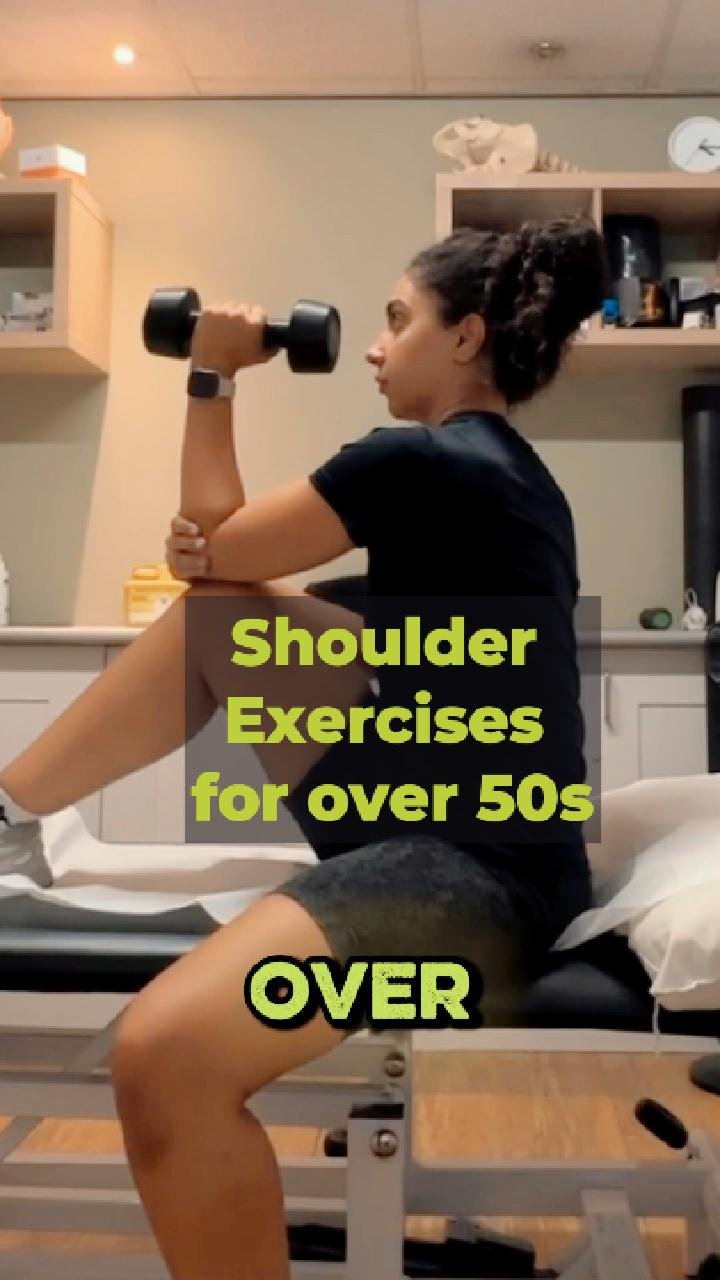
Exercise 3: Elbow-supported external rotation (for the rotator cuff)
Rest your elbow on your knee while seated, keep it tucked at your side, and rotate your forearm outward and up, then lower it back down slowly. Fixing the elbow against your knee like this stops your bigger shoulder muscles from taking over, so the smaller rotator cuff muscles, mainly infraspinatus and teres minor, have to do the work instead.
This matters because research using fine-wire EMG to measure exactly which shoulder muscles fire during common external rotation exercises found that positions which pin the elbow at the side, rather than letting it float away from the body, produce the highest activation of infraspinatus and teres minor relative to the deltoid.2 Bracing your elbow on your knee achieves the same principle in a simple seated position.
Worth knowing before you start
Start light, particularly with the external rotation. It’s a small muscle group doing a lot of stabilising work and it fatigues quickly, so a couple of light kilos and controlled reps beats swinging a heavy dumbbell through a sloppy range every time.
If you’ve got shoulder pain that’s new, sharp, or comes with clicking, catching or a feeling of instability, that’s a reason to get an assessment before loading it further rather than a reason to push through. A physio can quickly work out whether these exercises are the right starting point for you or whether something else needs sorting first.
| # | Fact |
|---|---|
| 1 | A single-arm row trains the muscles that pull your shoulder blade back and down, the ones most desk-based pressing and screen time leaves under-worked.1 |
| 2 | A seated shoulder press removes the temptation to use momentum from your legs or lower back, so it’s an easier position to keep good form in than a standing press. |
| 3 | Bracing your elbow against your knee during external rotation isolates the rotator cuff far more effectively than letting the elbow drift away from the body.2 |
| 4 | The rotator cuff is a group of small, deep muscles rather than one big one, which is exactly why it needs light, targeted loading rather than heavy weight. |
| 5 | Between them, a row, a press and a rotation cover the three basic movement patterns a shoulder needs to be strong and stable through its full range. |
Watch the exercises
When shoulder pain needs more than exercise
These three moves are a solid maintenance routine for a healthy shoulder, but they’re not a substitute for an assessment if your shoulder pain is new, severe, or hasn’t settled with rest and gentle movement. Shoulder pain has a lot of possible causes, from rotator cuff problems to impingement to referred pain from your neck, and getting the right diagnosis first means your exercise plan actually targets the cause. Our guide to shoulder pain covers what to expect from a proper assessment if you’d like to read more before booking in.
Our approach: every tool for your best recovery
At BOOST PHYSIO, we believe your best recovery comes from having every tool available, not relying on just one. That’s why our physiotherapists combine hands-on manual therapy with targeted exercise rehabilitation, tailored specifically to you and adjusted as you progress. It’s the thinking behind our promise: Your Best Recovery, Guaranteed.
At BOOST PHYSIO Swiss Cottage, based inside the Virgin Active Gym at the O2 Centre, we offer:
- ✓ Same day physiotherapy appointments
- ✓ Full access to the gym floor and pool for rehab exercises
- ✓ Treatment recognised by Bupa, AXA Health, Vitality and WPA
Book your assessment with Setareh online now, call 020 8201 7788 or WhatsApp us.
Frequently asked questions about shoulder exercises with a dumbbell
What weight dumbbell should I start with?
How often should I do these exercises?
Why does the external rotation need my elbow braced on my knee?
Can these exercises help with existing shoulder pain?
Do I need all three exercises, or just one?
[boost_locations_block] [boost_locations_schema]
Written with Setareh Radfar, Chartered Physiotherapist at BOOST PHYSIO Swiss Cottage, and the BOOST PHYSIO team. This article is general guidance and is not a substitute for an individual physiotherapy assessment. References: (1) Fenwick CM, Brown SH, McGill SM, “Comparison of Different Rowing Exercises: Trunk Muscle Activation and Lumbar Spine Motion, Load, and Stiffness”, Journal of Strength and Conditioning Research, 2009;23(5):1408-1417. (2) Reinold MM, Wilk KE, Fleisig GS, et al, “Electromyographic Analysis of the Rotator Cuff and Deltoid Musculature During Common Shoulder External Rotation Exercises”, Journal of Orthopaedic & Sports Physical Therapy, 2004;34(7):385-394.