

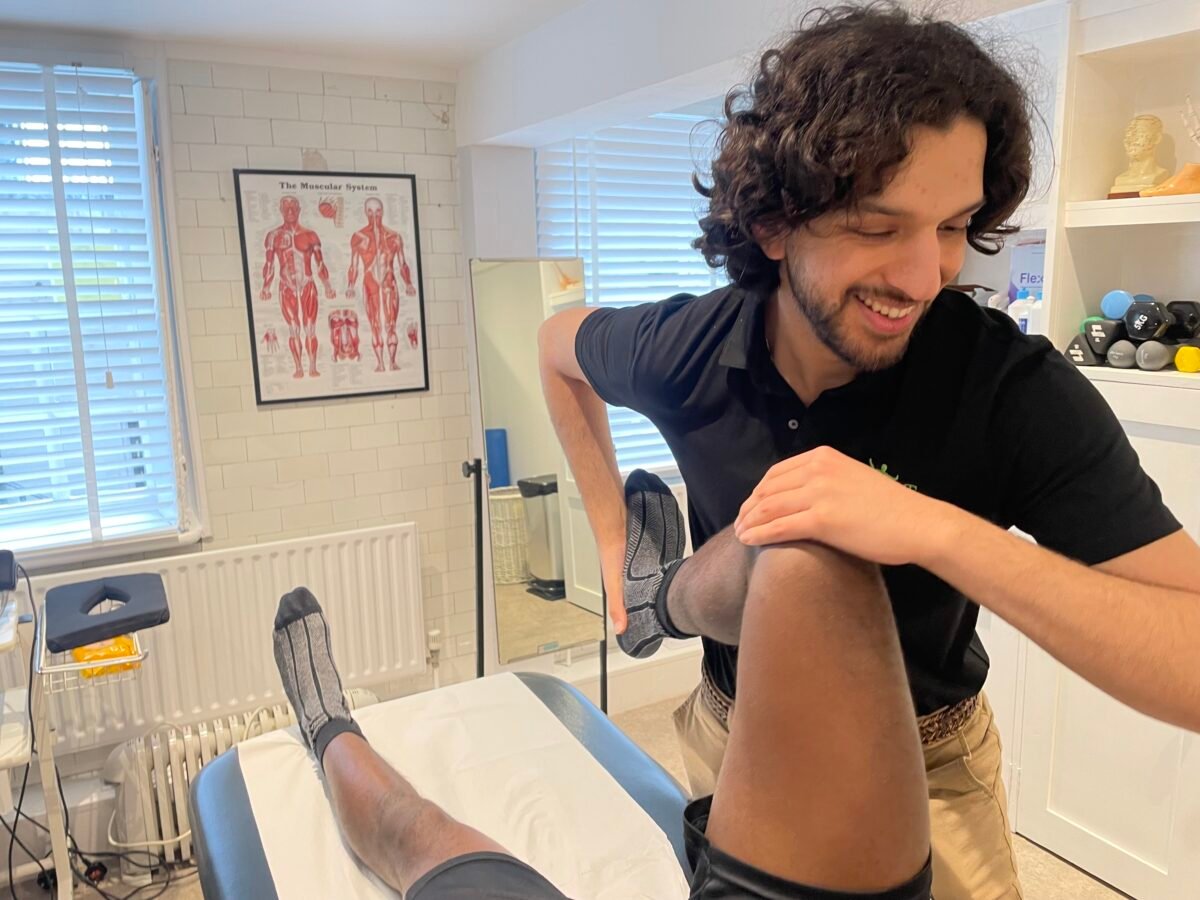
Physio after knee replacement: walk, bend and live with confidence
Had a total knee replacement, or have one coming up? Expert rehab from the first week helps you get your bend back, walk without a stick and return to the things you love.
★★★★★ Over 1,000 five-star Google reviews · 38,000+ people helped
Quick answer: physiotherapy after a total knee replacement helps you get your knee bending and straightening, rebuild strength and walk normally again. Always follow your surgeon’s guidelines first. Where they agree, we usually start about 7 days after the operation, then see you once or twice a week until you can manage stairs without a stick and drive, before focusing on hobbies and sport from around 6 to 12 weeks. The work you do between sessions matters as much as the sessions themselves.
In this guide · 8 min read
- A new knee is a big step. We’ll walk it with you
- When should physio start after a knee replacement?
- Total knee replacement recovery on video, week by week
- What your rehab focuses on
- How our physios help you recover
- Knee replacement insight from leading surgeons
- Waiting for your operation? Start now
- 5 questions to ask before you choose a physio
- What your recovery looks like
- Every tool for your best recovery
- Knee replacement physio near you
- Your questions answered
A new knee is a big step. We’ll walk it with you
You’ve probably waited a long time for this operation, maybe years of pain, stiffness and giving up things you love. Now it’s done, it’s natural to feel a mix of relief, tiredness and worry. Is it supposed to be this swollen? Am I bending it enough? Am I doing the right exercises?
Those first weeks shape how well your new knee works for years to come. Having an experienced physio beside you, checking your progress and adjusting your plan, takes the guesswork and a lot of the worry away.
If you had a partial (uni) knee replacement, see our partial knee guide. The principles are similar but recovery is often quicker.

02 · When to start
When should physio start after a knee replacement?
Your surgeon’s guidelines always come first. Where they don’t say otherwise, this is the approach our physios recommend.
| About 7 days after surgery | Your first session. We check how you’re walking, that you’re doing the right exercises correctly and look out for complications such as a blood clot (DVT) or wound infection. |
|---|---|
| Weeks 1 to 6 | Usually one or two sessions a week. We work on bending and straightening the knee, swelling, walking pattern and strength. We wean you off crutches or a stick when you’re ready. |
| Around 6 weeks | Most people can manage stairs without a stick and many are cleared by their surgeon to drive. Exercise moves from the basics to proper strength work. |
| 6 to 12 weeks | Getting you back to what you love: longer walks, the gym, swimming, golf, cycling, gardening or playing with grandchildren. |
| 3 to 12 months | Your knee keeps improving for a year or more. Keeping up strength work protects your result long term. |
Studies suggest that between 10% and 34% of people still have troublesome pain long after a knee replacement. Good rehab, the right exercises and early help when progress stalls give you the best chance of a great result.
Beswick et al, BMJ Open 2012
03 · Recovery on video
Total knee replacement recovery on video, week by week
These short videos from the BOOST PHYSIO team show real patients and the exercises and advice our physios give after a total knee replacement (TKR) at our clinics across North London and Hertfordshire. Always check with your physio or surgeon which exercises are right for you and stop if an exercise makes your pain much worse.
Days 1 to 14: getting moving safely

Exercises to start straight after your knee replacement
The first moves our physios teach after total knee replacement surgery, to get the knee bending and straightening safely while it’s still swollen and stiff in the first 2 weeks.
The essential exercises for your first 2 weeks
Why the early exercises your physio gives you after a knee replacement matter so much and how to do them well at home between sessions.

A real patient, 1 week after her knee replacement
Our patient shows the key exercise our physios recommend in the first weeks after total knee replacement surgery.

Your early post-op exercise plan
Gentle movement, swelling control and switching the thigh muscle back on: the common early plan after knee surgery, demonstrated by our physio.
Around 2 weeks: what to expect

How you might feel 2 weeks after a knee replacement
This patient had her right knee replaced 2 weeks earlier and is walking without crutches. You can see the swelling and bruising that are normal at this stage.

Walking 10 days after a knee replacement
What walking usually looks like in the first couple of weeks after total knee replacement, shown by a patient 10 days after surgery.

How your knee may look at 2 weeks
Swollen and bruised with dressings is normal 10 to 14 days after a knee replacement. Real examples, so you know what to expect.
Swelling and stiffness

How to reduce swelling after knee surgery
Swelling is one of the biggest barriers to getting your strength and movement back after a knee replacement. Simple ways to help it settle.

Stiff knee after a knee replacement?
Most patients feel tightness and limited movement in the first weeks after a knee replacement. How our physios help you get your bend back.
From 2 weeks to 3 months: rebuilding strength

Switching your quads back on after 2 weeks
After a knee replacement the quadriceps at the front of the thigh switch off because of swelling, pain and surgery. This exercise helps you straighten the knee and rebuild strength.

Can I squat after a knee replacement?
We usually recommend mini-squats from around week 2 after total knee replacement surgery to help rebuild the quads, as long as your surgeon agrees.

What really helps your recovery
How much the right physiotherapy rehab helps in the first few weeks after a knee replacement and how easy it is to stall without it.

Gym-based rehab after knee surgery
What later-stage knee rehab can look like in the gym, using resistance machines for controlled, guided strengthening.

How you might be 3 months after a knee replacement
The first weeks can feel overwhelming. Here’s how life often looks 3 months after a total knee replacement, with steady rehab.
04 · What we work on
What your rehab focuses on
Getting your bend back
Knee flexion
Enough bend to climb stairs, get in and out of a car and rise from a chair. Stiffness is easiest to tackle in the early weeks.
Getting it straight
Knee extension
A knee that straightens fully makes walking easier and less tiring. It’s one of the most important early goals.
Calming swelling
Pain and swelling
Elevation, ice, compression and pacing your activity, so swelling doesn’t hold you back.
Walking well
Gait and balance
Walking without a limp, then without crutches or a stick, with good balance to prevent falls.
Strength
Quads, hips and calves
The quadriceps muscle switches off after surgery. Rebuilding it is the key to stairs, confidence and stability.
Your goals
Back to life
Driving, work, travel, golf, tennis, cycling or the gym. We build your plan around what matters to you.
★★★★★
“I recently had knee replacement surgery and started seeing Madeleine at the Hampstead branch. From my very first appointment, she made me feel completely at ease.”
Petra M, Hampstead, Google review
★★★★★
“Most recently, to help me recover from simultaneous hip and knee replacements, she has patiently taken me though the process of building back surrounding muscle strength to enable me to return to tennis.”
James S, Swiss Cottage, Google review
★★★★★
“I had a very good experience here with Tyrone who really helped me improve movement in my knee following knee replacement surgery. He also taught me good exercises I can do outside of our sessions to keep improving.”
Eusebia L, Mill Hill, Google review
★★★★★
“I had a session at Boost with Mrs Micki Hammond and she is amazing and really helping me get back on my feet after a revision Knee replacement.”
Rosalyn L, Hendon, Google review
05 · How we help
How our physios help you recover
- A thorough first assessment: your knee, wound, swelling, walking and how you’re coping at home
- Hands-on treatment to ease pain and stiffness and help the knee move
- A clear exercise plan that progresses as you do, sent to you so you know exactly what to do at home
- Gym-based rehab at clinics inside gyms and leisure centres, with bikes and strength equipment
- Help with the hard bits: stairs, getting in and out of the car, sleeping and getting back to driving
- Close contact with your surgeon’s team if anything isn’t progressing as it should

Madeleine Paterson
Senior Physiotherapist, Hampstead NW3
Maddy has a First Class BSc in Physiotherapy from Brunel University London. She helps people recover from joint replacements, arthritic joints and sports injuries with a warm, encouraging approach, as her patients’ reviews after knee replacement show.
06 · From the surgeons
Knee replacement insight from leading surgeons
We work closely with leading orthopaedic surgeons. They regularly share their expertise with our team so your rehab matches the latest surgical care.

Knee replacement in younger people: Mr David Sweetnam
Consultant orthopaedic knee surgeon Mr David Sweetnam talks about total knee replacement surgery in younger people. We often rehab patients in their late 40s and early 50s after a knee replacement.

Robotic knee replacement: Mr Jonathan Miles
Consultant orthopaedic surgeon Mr Jonathan Miles explains how robotics are being used in hip and knee replacement surgery.
07 · Before surgery
Waiting for your operation? Start now
Getting stronger before a knee replacement, often called prehab, helps you know your exercises before the operation and can make the first weeks afterwards easier. We’ll also help you plan your home, from a chair of the right height to a step-by-step plan for the stairs.
08 · Choosing your physio
5 questions to ask before you choose a physio
- How often do you treat knee replacements? We see people after knee and hip replacement every week across our clinics.
- Do you work with surgeons? We have close links with leading orthopaedic surgeons and will follow your surgeon’s protocol.
- Can I be seen quickly? We offer same day appointments, so you can start on time rather than waiting weeks.
- Is there a gym? Several of our clinics are inside gyms and leisure centres, ideal for later-stage strength work.
- Will my insurance cover it? We’re recognised by Bupa, AXA Health, Vitality, Aviva and WPA. Check your post-operative physio cover with your insurer.
09 · Your recovery
What your recovery looks like
Settle and move
Calm the swelling, start bending and straightening the knee and walk safely with your aids.
Strengthen
Build your quads and hips, lose the stick and master the stairs and the car.
Live fully
Longer walks, the gym, golf, swimming or cycling, with a plan to keep your new knee strong.
When to get help urgently after a knee replacement
Call 999 if you have chest pain or sudden breathlessness, which can be a sign of a blood clot in the lungs.
Contact your surgeon’s team or GP the same day if your calf is painful, hot or swollen, your wound is red, hot, leaking or smells, you have a fever or feel unwell, or your pain suddenly gets much worse.
Why BOOST PHYSIO
Every tool for your best recovery
We believe your best recovery comes from having every tool available, not relying on just one. So you’ll get hands-on treatment to ease pain and get you moving, exercise rehab that’s built around your life and a clear plan that changes as you improve.
Here’s something our patients don’t always realise. Behind every BOOST physio is the whole team. We train together twice a month and every physio has a dedicated mentor who reviews cases with them. If your problem is unusual or stubborn, it gets talked through by people who have seen it many times before.
- Same day appointments, 8am to 9pm, seven days a week at most clinics
- No GP referral needed
- On average our patients reach their goals in around 5 sessions
- Close links with leading orthopaedic surgeons and sports doctors if you need a scan or an opinion
- Recognised by Bupa, AXA Health, Vitality, Aviva and WPA, or simply self-pay
10 · Near you
Knee replacement physio near you
See a BOOST PHYSIO physio after your knee replacement at any of our clinics across North London and Hertfordshire, with early morning, evening and weekend appointments.
Ready to get the most from your new knee?
Book your first post-op session and leave with a clear plan. Your Best Recovery, Guaranteed.
Related reading
Keep reading
Your questions
Your questions answered
When should I start physio after a knee replacement?
Follow your surgeon’s guidelines first. Where they don’t say otherwise, we usually recommend starting about 7 days after the operation, then one or two sessions a week until you can manage stairs without a stick and drive.
How many physio sessions will I need after a knee replacement?
It varies with your progress and goals. Most people have one or two sessions a week for the first 6 weeks or so, then less often as they move on to strength work and hobbies. Your home exercises matter as much as the sessions.
How long does it take to recover from a total knee replacement?
Most people walk without a stick and manage stairs by around 6 weeks and get back to hobbies between 6 and 12 weeks. The knee keeps improving for a year or more as strength builds.
How much should my knee bend after a knee replacement?
Enough to manage stairs, get in and out of a car and rise from a chair comfortably. Your surgeon and physio will set targets for you. Bend is easiest to improve in the first weeks, which is why starting physio on time helps.
Is it normal for my knee to be swollen and stiff?
Yes. Swelling and stiffness are normal for weeks and can last a few months. Elevation, ice, compression and pacing help. If your knee becomes hot, red or much more painful, contact your surgeon’s team.
When can I drive after a knee replacement?
Many people are ready at around 6 weeks, but check with your surgeon and your car insurer. You need to be able to perform an emergency stop safely.
Can I have physio at home after my knee replacement?
Home visits depend on your specific needs and are best discussed with our team. Many people find coming to a clinic with a gym helps them progress faster once they are walking.
What exercises should I do after a knee replacement?
Early on, exercises to bend and straighten the knee, tighten the quads and walk well. Later, strength and balance work such as sit to stand, step-ups and the exercise bike. We’ll tailor and progress them for you.
Can I squat after a knee replacement?
Usually yes, gradually. Our physios often start mini-squats from around week 2 after a total knee replacement to help rebuild the quads, as long as your surgeon agrees. Depth builds as strength and bend improve.
Are there videos of knee replacement exercises I can follow?
Yes. This page has BOOST PHYSIO videos showing real patients and the exercises our physios use from the first days after surgery to 3 months. Check with your physio which ones suit your stage of recovery.
Should I have physio before my knee replacement?
It can help. Prehab builds strength, teaches you your exercises before the operation and helps you plan for coming home.
Will my health insurance cover physio after a knee replacement?
Many policies cover post-operative physio. We’re recognised by Bupa, AXA Health, Vitality, Aviva and WPA. Check your cover and get an authorisation number from your insurer before your first session.
Do I need a referral from my surgeon?
No. You can book directly. It helps to bring any discharge notes or exercise sheets from the hospital so we can follow your surgeon’s protocol.
Where can I see a knee replacement physio near me?
We have clinics in Hendon, Hampstead, Swiss Cottage, West Hampstead, Kentish Town, Hampstead Garden Suburb, East Finchley, Muswell Hill, Crouch End, Mill Hill, Kensington, Borehamwood and Elstree.
Written by Steven Berkman, Chartered Physiotherapist and founder of BOOST PHYSIO, with the BOOST PHYSIO clinical team. Reviewed November 2026. This guide is general information and not a substitute for an individual assessment by a physiotherapist or doctor.
References
- Beswick AD, Wylde V, Gooberman-Hill R, Blom A, Dieppe P. What proportion of patients report long-term pain after total hip or knee replacement for osteoarthritis? A systematic review of prospective studies in unselected patients. BMJ Open 2012;2:e000435.
- Artz N, Elvers KT, Lowe CM et al. Effectiveness of physiotherapy exercise following total knee replacement: systematic review and meta-analysis. BMC Musculoskeletal Disorders 2015;16:15.
