
What Doctors And Surgeons Say

“My patients have been very well looked after by the professional team at BOOST PHYSIO.”

“When referring patients to BOOST PHYSIO I know I can rely on professional evidence-based, high quality treatment from friendly therapists.”

“BOOST PHYSIO have always taken good care of my patients.”
“Very professional clinic. Would highly recommend BOOST PHYSIO.”

“BOOST Physio have been a fantastic resource for my patients, particularly those with complicated problems or those who are going through post-op rehab. They are highly skilled, and really help motivate patients to get back to being active. An all-round fab team!”
“Fantastic physios. BOOST have always looked after me well.”

“BOOST PHYSIO has provided a timely, efficient and highly professional service to many of my patients, which has helped them in their post-op recovery back to full function.”
“My shoulder is completely better.”
“I have always found BOOST to be extremely helpful and efficient when dealing with my patients.”

“BOOST PHYSIO offer an exceptional service for my patients. With several locations across North London, and great communication, it’s great to receive positive patient feedback.”
Written by Travis Egerton, BSc (Hons) Physiotherapy, MCSP, HCPC Registered | Senior Physiotherapist, BOOST PHYSIO | Updated June 2026
Most of us spend a lot of time thinking about our lower backs, our necks and our knees. But there is one part of the spine that quietly causes enormous problems for thousands of people - and most of them have absolutely no idea it is the issue.
Your upper back - or thoracic spine - is designed to rotate, extend and move freely. When it does not, the body compensates. Your neck overworks. Your shoulders strain. Your lower back takes on load it was never meant to carry. Over time, this leads to stiffness, pain and injury that often feels completely unrelated to your upper back.
The good news? A stiff thoracic spine is very treatable. But first - you need to know if yours is actually moving the way it should.
Physiotherapy for Upper Back Stiffness?
The thoracic spine is the middle section of your back, running from the base of your neck down to your lower back - roughly the area where your ribcage attaches. It consists of 12 vertebrae (T1-T12) and is built differently from the neck and lower back: it is designed primarily for rotation and extension, not flexion. This is what allows you to twist, reach overhead and maintain an upright posture.
The problem is that modern life - desk jobs, driving, smartphones - keeps the thoracic spine locked in a flexed, rounded position for hours at a time. Over weeks and months, the joints, muscles and fascia in this region stiffen and lose their natural range of motion.
When thoracic mobility is poor, the body does not simply stop moving - it finds another way. The most common compensation patterns we see at BOOST PHYSIO are:
- Neck pain and headaches - the cervical spine rotates more than it should to compensate for reduced thoracic rotation
- Shoulder impingement and rotator cuff problems - reduced thoracic extension limits the ability of the shoulder blade to move correctly
- Lower back pain - the lumbar spine picks up rotational load it was not designed to handle
- Postural fatigue - muscles work overtime trying to maintain upright alignment against a stiff thoracic spine
This is why so many patients come to us with neck or shoulder pain, and we identify the true source of the problem as thoracic stiffness.
Try This Simple Test at Home
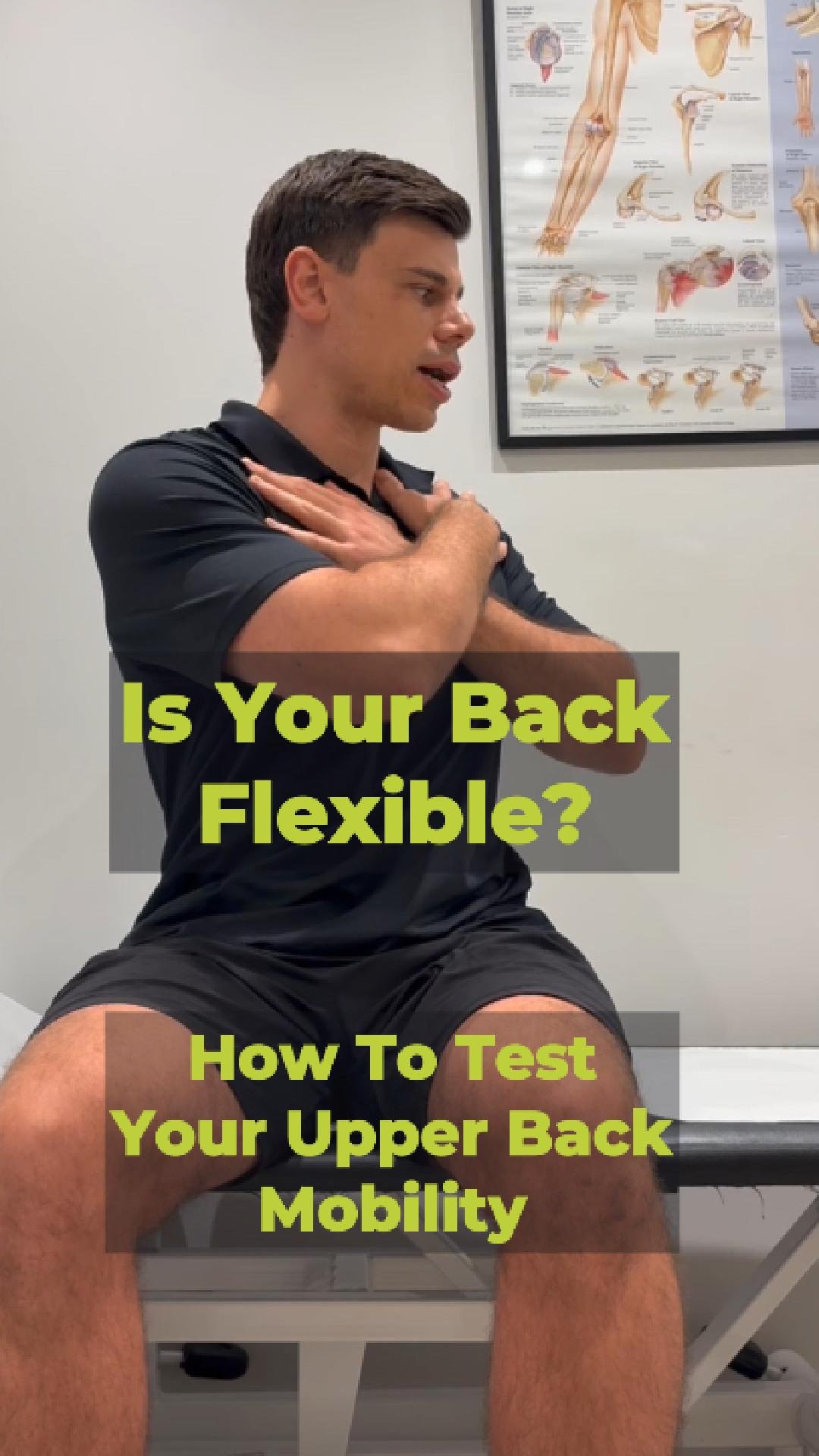
Our physiotherapist Travis demonstrates a quick and easy self-assessment you can do right now to check your thoracic mobility. It takes less than a minute and requires no equipment.
▶ Watch: Upper Back Flexibility Test with Travis
Give it a try and see how you get on. If you notice restriction, asymmetry or discomfort on one side more than the other, that is useful information - and something a physiotherapist can help you address. Even mild restriction is worth taking seriously before it creates compensatory problems elsewhere.
What to look for:
- Are you able to rotate equally to both left and right?
- Do you feel tightness or pulling across your upper back?
- Is your movement smooth and pain-free, or does it feel stiff and effortful?
What Causes a Stiff Thoracic Spine?
Thoracic stiffness is extremely common - particularly in adults over 30 who spend significant time at a desk, drive regularly or use a smartphone frequently. The most common causes we see include:
- Prolonged sitting and desk work - sustained flexion tightens the anterior chest structures and weakens the thoracic extensors
- Previous injury or trauma - rib fractures, whiplash or back injuries can lead to long-term protective stiffness
- Osteoarthritis - age-related joint changes in the thoracic facet joints reduce range of motion
- Breathing pattern disorders - shallow, upper chest breathing reduces thoracic mobility over time
- Repetitive sport or occupation - cyclists, rowers and office workers are particularly prone
Two Exercises to Help Loosen a Stiff Upper Back
If the test revealed some stiffness, here are two gentle exercises that can make a real difference. We recommend doing these daily, particularly if you sit at a desk for long periods. Start gently, work within a comfortable range and build up gradually.
Exercise 1 - Wall W: Shoulder and Upper Back Opener
This exercise gently mobilises the thoracic spine and opens the chest, counteracting the rounded posture that builds up through the day. It targets the thoracic extensors, posterior shoulder capsule and the muscles between the shoulder blades.
How often: 2-3 sets of 10 repetitions daily
▶ Watch the Wall W Exercise on YouTube →Exercise 2 - Thoracic Extension Over a Towel
A simple but highly effective way to restore extension through the upper back. All you need is a rolled towel and a few minutes lying on the floor. This exercise directly targets the thoracic facet joints and stretches the anterior chest structures that restrict extension.
How often: Hold for 1-2 minutes per level, working through 2-3 positions along the thoracic spine
▶ Watch Thoracic Extension Over a Towel on YouTube →Important: If either exercise causes pain, sharp discomfort or symptoms spreading to your arms, stop immediately and seek advice from a physiotherapist before continuing.
How Physiotherapy Treats a Stiff Thoracic Spine
Self-care exercises are a brilliant starting point. But when stiffness is established - particularly if it has been present for months or is causing secondary problems elsewhere - hands-on physiotherapy treatment makes a significant difference to how quickly and fully you recover.
At BOOST PHYSIO, our physiotherapists use a combination of:
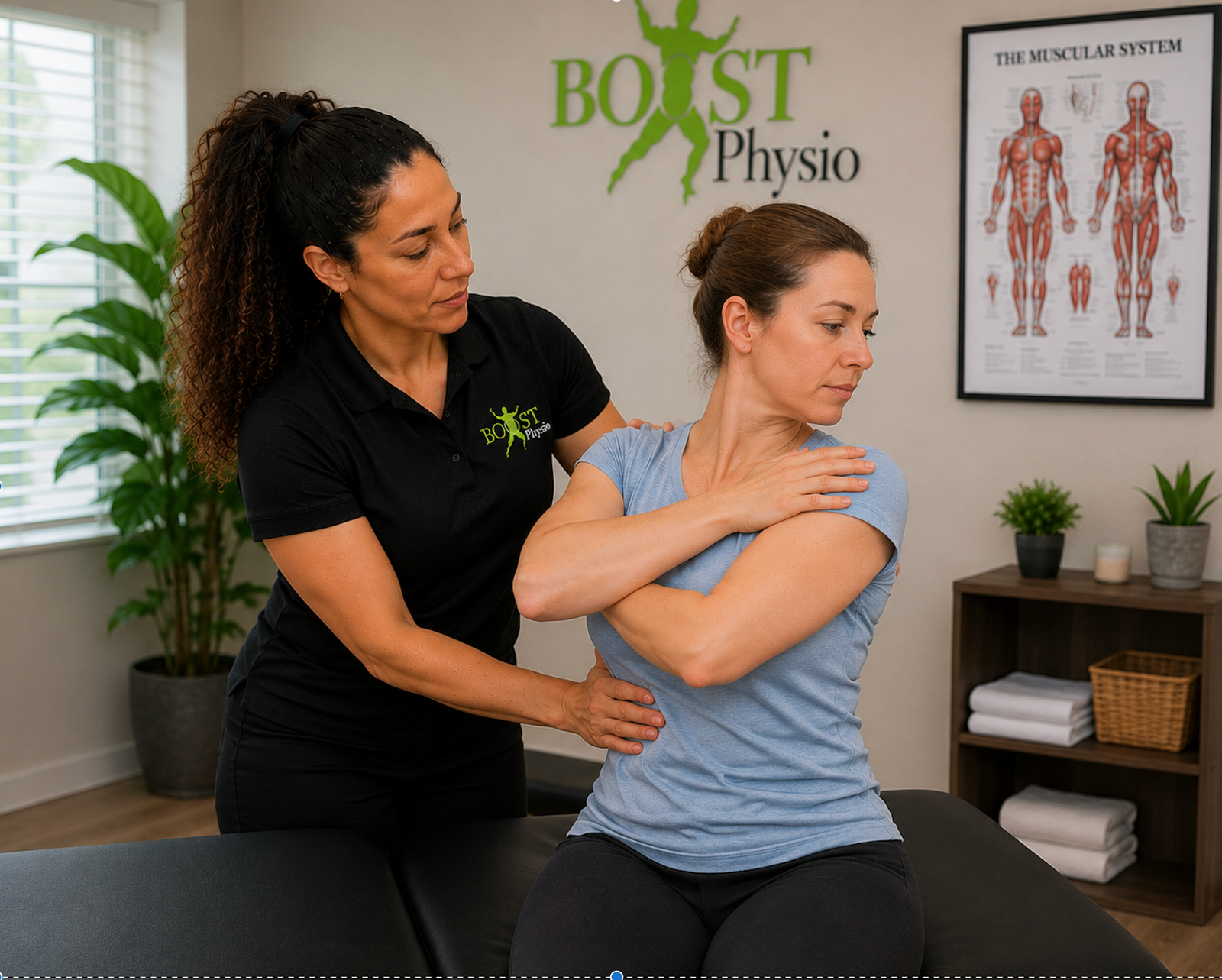
- Manual therapy and joint mobilisation - hands-on techniques to restore movement in specific thoracic segments that have become restricted
- Soft tissue release - targeted work on the erector spinae, rhomboids, thoracic fascia and surrounding musculature
- Thoracic manipulation - where clinically appropriate, spinal manipulation provides immediate improvements in range of motion
- Postural retraining - addressing the underlying movement habits and sitting postures that caused the problem in the first place
- A personalised exercise programme - building long-term thoracic mobility and strength to prevent recurrence
Most patients with thoracic stiffness notice meaningful improvement within two to four sessions, with a full programme typically spanning six to eight weeks depending on severity and how long the problem has been present.
"I had been suffering with neck pain and headaches for over a year. My GP referred me and within two sessions the physiotherapist had identified that my upper back was the root cause. The difference after six weeks of treatment was remarkable - I had no idea my thoracic spine was so restricted."
Patient at BOOST PHYSIO, North London ⭐⭐⭐⭐⭐
"I work at a desk all day and developed really painful shoulders. The team at BOOST PHYSIO diagnosed thoracic stiffness and gave me specific exercises and hands-on treatment. Three weeks in and I feel completely different. Wish I had come sooner."
Patient at BOOST PHYSIO, North London ⭐⭐⭐⭐⭐
When Should You See a Physiotherapist About Your Upper Back?
Self-care exercises are a great starting point, but it is worth seeking professional assessment if you experience any of the following:
- Upper back stiffness that has been present for more than two to three weeks
- Pain or restriction that is affecting your sleep, work or physical activity
- Symptoms spreading to your neck, shoulders or lower back
- Asymmetry - significantly better movement to one side than the other
- Stiffness that is not improving with self-directed exercise
- Upper back pain following a fall, accident or sporting injury
Our physiotherapists can identify exactly where the restriction is coming from, provide hands-on treatment to restore movement and build you a personalised programme to keep your thoracic spine moving well long term.
Same-Day Appointments Available
Open 8am - 9pm, seven days a week, across our clinics in North and North-West London and Hertfordshire. We accept Bupa, AXA Health, Vitality and WPA insurance.
Book Online Now →Conditions and Services Related to Upper Back Pain
- Neck Pain Treatment
- Shoulder Pain Physiotherapy
- Back Pain Treatment
- Postural Problems
- Sports Injury Rehabilitation
Find Your Nearest BOOST PHYSIO Clinic
- Hampstead NW3
- Swiss Cottage NW3
- Hendon NW4
- Muswell Hill N10
- East Finchley N2
- Mill Hill NW7
- Hampstead Garden Suburb NW11
- Borehamwood WD6
- Elstree WD6
- Kensington W8
Travis Egerton
BSc (Hons) Physiotherapy | MCSP | HCPC Registered | Senior Physiotherapist, BOOST PHYSIO
Travis is a senior physiotherapist at BOOST PHYSIO with extensive experience in musculoskeletal assessment and treatment, including spinal conditions, sports injuries and post-operative rehabilitation. He works across multiple BOOST PHYSIO clinics in North London and is passionate about patient education and exercise-based recovery. View Travis's full profile →
Frequently Asked Questions About Upper Back and Thoracic Spine Stiffness


Fees & Insurance
✅ 30 min Appointments from: £80
✅ 60min Appointments from £120
A 30min appointment enables us to fully assess your knee issue. If you wish to have full treatment at the same visit and you are self-paying, book a 60min appointment. For insured patients we only provide 30min appointments.
We are recognised by major medical insurers:
✅ BUPA
✅ AXA
✅ WPA
✅ Vitality
✅ AVIVA
