


Sports physio in London: back to the sport you love, stronger
Injured running, playing football, in the gym or on the padel court? See an experienced sports physio for a clear diagnosis, a plan that keeps you training and a safe return to sport.
★★★★★ Over 1,000 five-star Google reviews · 38,000+ people helped
Quick answer: a sports physio diagnoses and treats injuries from sport and exercise, such as muscle strains, ligament sprains, tendon pain and knee or shoulder injuries, then guides you back to full training. Most sports injuries don’t need complete rest. The quickest, safest recovery usually comes from an accurate diagnosis, a few days of protection, then progressive strength and movement training while you keep fit in ways that don’t aggravate the injury. When you go back should be decided by tests of strength, movement and confidence, not just by how many weeks have passed.
In this guide · 8 min read
- Injured and out of action? We get it
- What does a sports physio actually do?
- Sports injuries we treat
- A sports physio who understands your sport
- How our sports physios treat your injury
- Will I lose all my fitness?
- Training for a marathon, triathlon or big match?
- Returning to sport: it’s a journey, not a single day
- Every tool for your best recovery
- Sports physio near you
- Your questions answered
Injured and out of action? We get it
A sports injury rarely arrives at a good time. It might be weeks before a marathon, halfway through the football season or just as your gym routine was finally paying off. On top of the pain there’s the worry about losing fitness, missing your event and whether it will ever feel right again.
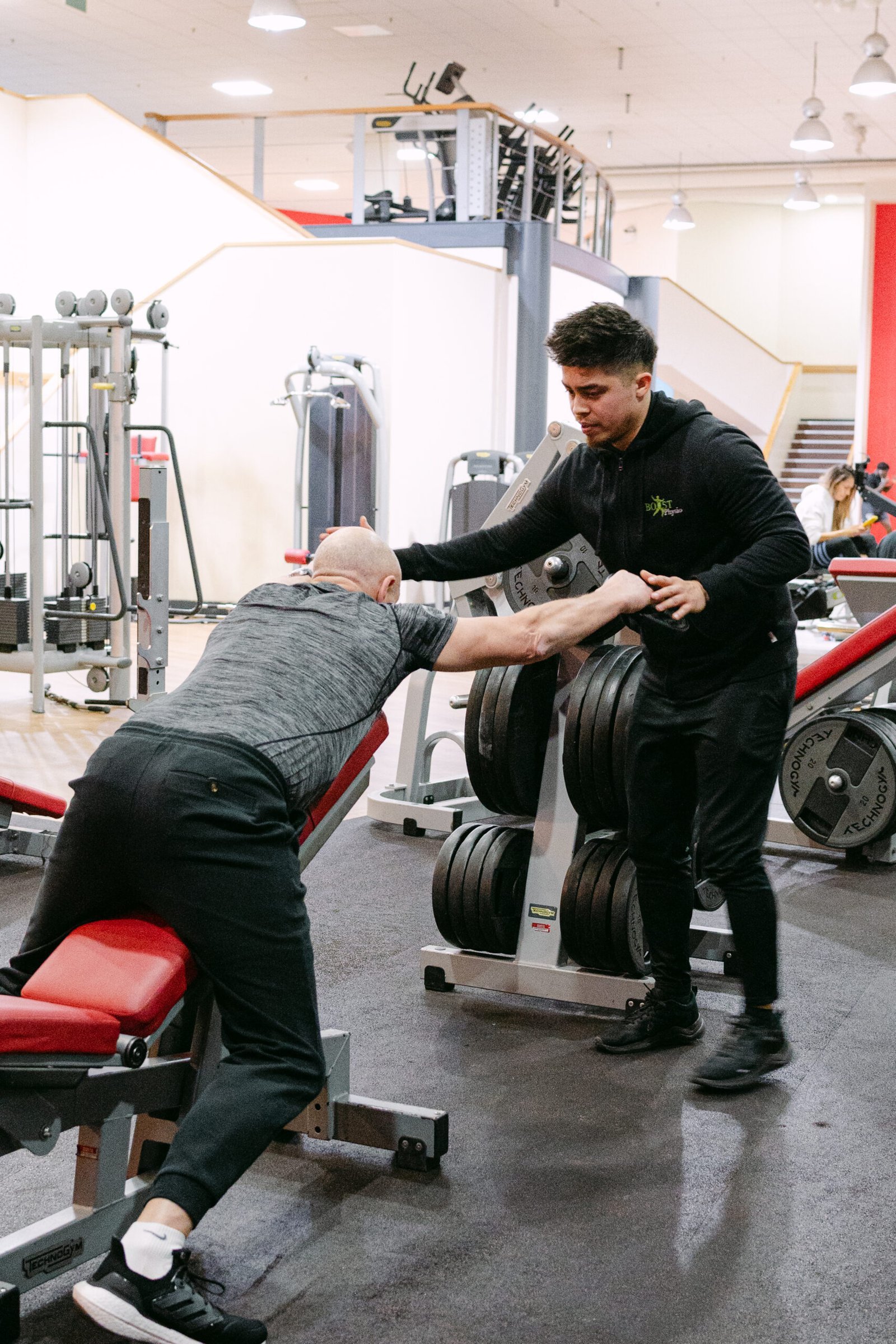
The good news is that being injured rarely means stopping everything. With the right plan you can protect the injury, keep the rest of your body training and come back better prepared than before. That’s what our sports physios help people do every day, from parkrunners and weekend footballers to triathletes, dancers, golfers and club players.
02 · Sports physio
What does a sports physio actually do?
A sports physio is a physiotherapist who specialises in injuries from sport and exercise. You don’t need to be an athlete to see one. If you run, lift, cycle, swim, play five-a-side or simply want to stay active, a sports physio is the right person to see.
- Finds out what’s injured and why, including your training load, technique and any old injuries
- Eases pain with hands-on treatment such as soft tissue release and joint mobilisation
- Rebuilds strength, power and control with progressive exercise in clinic and in the gym
- Keeps you fit with a cross-training plan that doesn’t load the injury
- Tests you before you go back with strength, hopping, sprinting, cutting or sport-specific drills
- Gets you a scan or specialist opinion quickly when it’s genuinely needed
Sports physio or sports massage? Massage can ease tight, sore muscles and is a great part of training. A sports physio goes further: a diagnosis, a rehab plan and a decision on when it’s safe to return. If you’re injured, start with a physio.
03 · What we treat
Sports injuries we treat
Muscle strains and tears
Hamstring, calf, groin and quad
Often from sprinting, kicking or changing direction. Rehab rebuilds strength at speed to stop it happening again. Groin strain physio
Ligament sprains
Ankle, knee and wrist
Rolled ankles and twisted knees are some of the most common injuries we see. Ankle sprain physio
Knee injuries
ACL, meniscus, runner’s knee
From kneecap pain to ligament and cartilage injuries, with or without surgery. Knee pain physio
Tendon pain
Achilles, patellar, tennis elbow
Tendons respond best to the right amount of loading, not rest alone. Achilles tendon physio
Running injuries
Shin splints, heel pain, ITB pain
Usually a mismatch between training load and what your body can handle right now. We help you find and fix it. Running injury physio
Shoulder and elbow injuries
Rotator cuff, dislocation, racket sports
Common in swimming, tennis, padel, climbing and the gym. Tennis elbow physio
Back, hip and groin pain
Including hip impingement
Pain that stops you running, kicking, lifting or swinging a club. Hip pain physio
Rehab after sports surgery
ACL, cartilage and shoulder repair
Step-by-step rehab from the first week after surgery all the way back to sport. ACL rehab
Recurring niggles
The injury that keeps coming back
We look at the whole picture, from strength gaps to training habits, so it doesn’t return next season.
Endurance fitness can be maintained for up to 15 weeks with as few as 2 training sessions a week, as long as you keep the intensity up. Being injured doesn’t have to mean starting from scratch.
Spiering et al, Journal of Strength and Conditioning Research 2021
04 · Your sport
A sports physio who understands your sport
Every sport loads the body differently, so your rehab should look like your sport by the end. Here’s how we tailor it.
Running
Parkrun to marathon
Load management, strength for calves, hips and knees plus a realistic run-back plan so race day is still on.
Football and rugby
Five-a-side to club level
Sprinting, cutting, kicking and contact drills, with hamstring and groin injury prevention built in.
Tennis, padel and golf
Racket and club sports
Shoulder, elbow, back and hip work, plus rotation and grip strength for every swing.
Gym, CrossFit and lifting
Strength sports
Technique, programming and smart modifications so you keep lifting while the injury heals.
Cycling and triathlon
Endurance sports
Knee, back and neck pain on the bike, swim shoulder and run injuries, managed across all three.
Skiing and snowboarding
Pre-season and after injury
Leg strength and balance before the trip and expert rehab after knee and shoulder injuries.
★★★★★
“I came to see him 3 days before my Marathon with severe knee pain, he was able to quickly diagnose the issue and provide a solution which allowed me to complete the entire marathon.”
Siddhant D, Swiss Cottage, Google review
★★★★★
“Recently I had an important football match that I was trying to play in despite a recent injury. The injury should have lasted about 18 weeks but he got fully ready to go in 6.”
Alessandro R, Swiss Cottage, Google review
★★★★★
“I was training for a marathon and picked up many injuries which he has helped me to work through without impacting my performance. He managed the injury and the training load perfectly.”
Achilles G, Swiss Cottage, Google review
★★★★★
“I wouldn’t have been able to run the marathon without his help treating my shin splints.”
Josh K, West Hampstead, Google review
05 · How we help
How our sports physios treat your injury
| First few days | Protect the injured area for 1 to 3 days, avoid what clearly makes it worse and use compression and elevation for swelling. Then start moving it gently. |
|---|---|
| Do I need complete rest? | Rarely. Long periods of rest weaken the injured tissue. Gradual, well-judged loading helps it heal stronger. |
| Main treatment | Accurate diagnosis, progressive strength and movement exercise, hands-on treatment where it helps and a staged return to running, training and sport. |
| Keeping fit while injured | Most people can keep training: cross-training, strength work for unaffected areas and even training the uninjured side. |
| How long it takes | Mild strains and sprains often settle in a few weeks. Tendon problems and more severe injuries can take several months. After ACL reconstruction, return to pivoting sport is usually around 9 months or more. |
| When to return | When you pass tests of strength, movement, sport-specific skills and confidence, not on a set date. |
Dan Burgin
Sports and Rehabilitation Therapist and Clinical Lead, Swiss Cottage and East Finchley
Dan has over 10 years in private healthcare, has led a spinal care team in Central London and has worked in elite sport. He uses manual therapy, taping, exercise rehab and plyometrics to get footballers, runners, lifters and triathletes back to what they love. His patients’ reviews say it all.
06 · Your fitness
Will I lose all my fitness?
Not as quickly as most people fear. Fitness fades gradually rather than overnight. In highly trained athletes who stopped training completely, aerobic fitness (VO2max) fell by roughly 4 to 14% within the first 4 weeks.
The key word is completely. Keeping some training going makes a big difference and intensity matters more than volume. Shorter, harder sessions on the bike, in the pool or on the rowing machine can hold on to much of your fitness while the injury heals.
In a trial where one arm was kept in a cast for 4 weeks, people who strength trained their other arm lost only about 2% of strength in the immobilised arm, compared with about 22% in those who didn’t train.
Andrushko et al, Journal of Applied Physiology 2018
07 · Big event coming up?
Training for a marathon, triathlon or big match?
An injury in the middle of a training block is stressful, especially when the date is fixed and the fundraising is done. Here’s how we help you protect your goal.
- Cross-train to protect your fitness: cycling, swimming, pool running or rowing, chosen so they don’t load the injury
- Keep the intensity: it’s the key to holding on to fitness when training time is cut
- Train the uninjured side: strength training one limb helps preserve strength in the other
- Fix the neglected areas: strength, balance, mobility and core work that makes you more robust
- Rebuild your plan: a realistic run-back programme and an honest view on whether to race, adapt your goal or defer

How we helped a patient with shin splints get to the London Marathon finish

Setareh, our Swiss Cottage physio, on returning to sport

3 exercises for returning from a running injury

Weekend warrior? How to prevent injury
08 · Back to sport
Returning to sport: it’s a journey, not a single day
International sports physiotherapy experts recommend thinking of return to sport as a continuum that runs alongside your rehab, rather than one decision made at the end. After ACL reconstruction, for example, simple strength and function rules for when to return cut the risk of re-injury by 84% in one well-known study.
Return to participation
Back to modified training, such as non-contact drills, easy runs or lighter sessions, while you keep building strength.
Return to sport
Back to your full sport, matches or races, though not yet at your best.
Return to performance
Performing at or above your pre-injury level. For some, this is where personal bests happen.

Early exercises for a pulled calf muscle

Progressive exercises to prevent re-injury
When to get a sports injury checked urgently
Go to A&E or call 999 if you have a suspected broken bone, a deformed-looking joint or can’t put any weight through the limb; a head injury with confusion, vomiting, a worsening headache, drowsiness or any loss of consciousness; numbness, pins and needles or a cold, pale hand or foot; or chest pain or sudden breathlessness.
See a doctor or physio within a day or two if you have a painful, swollen or warm calf, especially after time in a boot or a long journey, or a knee that swelled quickly after a pop or twist.
Book an assessment if pain or swelling isn’t settling after a week or two, the injury keeps coming back or you want to return to sport safely. We offer same day physio appointments.
Why BOOST PHYSIO
Every tool for your best recovery
We believe your best recovery comes from having every tool available, not relying on just one. So you’ll get hands-on treatment to ease pain and get you moving, exercise rehab that’s built around your life and a clear plan that changes as you improve.
Here’s something our patients don’t always realise. Behind every BOOST physio is the whole team. We train together twice a month and every physio has a dedicated mentor who reviews cases with them. If your problem is unusual or stubborn, it gets talked through by people who have seen it many times before.
- Same day appointments, 8am to 9pm, seven days a week at most clinics
- No GP referral needed
- On average our patients reach their goals in around 5 sessions
- Close links with leading orthopaedic surgeons and sports doctors if you need a scan or an opinion
- Recognised by Bupa, AXA Health, Vitality, Aviva and WPA, or simply self-pay
09 · Near you
Sports physio near you
See a BOOST PHYSIO sports physio at any of our clinics across North London and Hertfordshire. Several are inside gyms and leisure centres, so your rehab can move straight from the treatment room to the gym floor. Shockwave therapy for stubborn tendon pain is available at Hendon, Hampstead, Swiss Cottage and Borehamwood.
Ready to get back in the game?
See an experienced sports physio and leave with a clear plan. Your Best Recovery, Guaranteed.
Related reading
Keep reading
Your questions
Your questions answered
What does a sports physio do?
A sports physio diagnoses and treats injuries from sport and exercise, eases pain with hands-on treatment, rebuilds strength and control with progressive exercise and tests you before you return to training and competition.
Do I need to be an athlete to see a sports physio?
No. Most of our sports physio patients are runners, gym-goers, weekend footballers, padel and tennis players or people who simply want to stay active. If exercise matters to you, a sports physio is a good fit.
Should I see a sports physio or have a sports massage?
If you’re injured, see a sports physio first. Massage can ease tight muscles, but a physio gives you a diagnosis, a rehab plan and a decision on when it’s safe to go back. Many people use both.
When can I return to sport after my injury?
It depends on the injury, your sport and how your rehab goes, so we use milestones rather than a fixed date. You’re usually ready when you have full movement, good strength compared with the other side and can complete sport-specific drills with confidence.
Should I rest a sports injury completely?
Rarely. A few days of protection helps, but long periods of rest weaken the injured tissue and your fitness. Gradual, well-judged loading helps it heal stronger.
Can I keep training while I am injured?
Usually yes. We’ll show you what you can safely keep doing, what to change and what to pause, including cross-training and strength work for the rest of your body.
I am training for a marathon or triathlon. What can I do while I recover?
Keep the intensity of your training up with cross-training that doesn’t load the injury, keep strength work going and rebuild your run plan gradually. We’ll give you an honest view on whether to race, adapt your goal or defer.
Do I need a scan or X-ray?
Most sports injuries can be diagnosed with a thorough assessment. If you might have a fracture, a significant ligament or cartilage injury or aren’t improving as expected, we can arrange a scan or a sports medicine or orthopaedic opinion quickly.
How many sports physio sessions will I need?
It depends on the injury. Across all our patients the average is around 5 sessions to reach their goals, with plenty of work done between sessions. Bigger injuries and surgery need longer.
How do I stop the injury coming back?
Finish your rehab rather than stopping when the pain goes, build strength and control for the demands of your sport and manage your training load. Return to sport testing helps show you’re ready.
Do I need a GP referral to see a sports physio?
No. You can book directly online, by phone or on WhatsApp. If you’re using health insurance, check with your insurer and bring your authorisation number.
Can I use my private health insurance?
Yes. Our physios are recognised by Bupa, AXA Health, Vitality, Aviva and WPA. You can also self-pay. See using your health insurance.
Where can I find a sports physio near me?
We have clinics in Hendon, Hampstead, Swiss Cottage, West Hampstead, Kentish Town, Hampstead Garden Suburb, East Finchley, Muswell Hill, Crouch End, Mill Hill, Kensington, Borehamwood and Elstree, with same day appointments available.
Written by Steven Berkman, Chartered Physiotherapist and founder of BOOST PHYSIO, with the BOOST PHYSIO clinical team. Reviewed November 2026. This guide is general information and not a substitute for an individual assessment by a physiotherapist or doctor.
References
- Ardern CL, Glasgow P, Schneiders A et al. 2016 Consensus statement on return to sport from the First World Congress in Sports Physical Therapy, Bern. British Journal of Sports Medicine 2016;50:853-864.
- Dubois B, Esculier JF. Soft-tissue injuries simply need PEACE and LOVE. British Journal of Sports Medicine 2020;54:72-73.
- Mujika I, Padilla S. Detraining: loss of training-induced physiological and performance adaptations. Part I. Sports Medicine 2000;30:79-87.
- Spiering BA, Mujika I, Sharp MA, Foulis SA. Maintaining physical performance: the minimal dose of exercise needed to preserve endurance and strength over time. Journal of Strength and Conditioning Research 2021;35:1449-1458.
- Andrushko JW, Lanovaz JL, Björkman KM et al. Unilateral strength training leads to muscle-specific sparing effects during opposite homologous limb immobilization. Journal of Applied Physiology 2018;124:866-876.
- Grindem H, Snyder-Mackler L, Moksnes H et al. Simple decision rules can reduce reinjury risk by 84% after ACL reconstruction: the Delaware-Oslo ACL cohort study. British Journal of Sports Medicine 2016;50:804-808.
