

Quick answer: cycling holds your hips flexed and your upper back rounded for long stretches at a time, which is great for aerodynamics and terrible for flexibility off the bike. A hip flexor stretch, a thoracic rotation and a split squat, done regularly, directly counter the three biggest postural side effects of time in the saddle: tight hips, a stiff upper back and side-to-side leg imbalances.
Why this matters
Cycling is a brilliant low-impact way to build fitness, but the position itself asks a lot of your body. Research looking at spinal posture in cyclists has found a consistent pattern: the more time spent pedalling, the more the thoracic spine tends towards a flexed, rounded position, and the more aerodynamic the riding position, the greater the hip flexion involved.1
None of that is a reason to stop cycling. It’s a reason to spend a few minutes off the bike undoing what the position asks of your body, which is exactly what our Swiss Cottage team recommend to the cyclists we see in clinic.
Exercise 1: Kneeling hip flexor stretch
Kneel in a half-lunge position, tuck your pelvis under slightly, and gently shift your weight forward until you feel a stretch down the front of your hip on the kneeling side. Reaching the same-side arm up and slightly back adds a bit of extra length through the front of the hip and lower ribs.
This directly addresses the shortened position your hip flexors sit in for the whole time you’re pedalling. Flexibility deficits in the hip flexors are recognised in the research as a potential biomechanical risk factor through the lumbo-pelvic-hip complex, with knock-on effects on posture through the trunk and lower limbs, which is exactly the chain cyclists are prone to.2
Exercise 2: Seated thoracic rotation
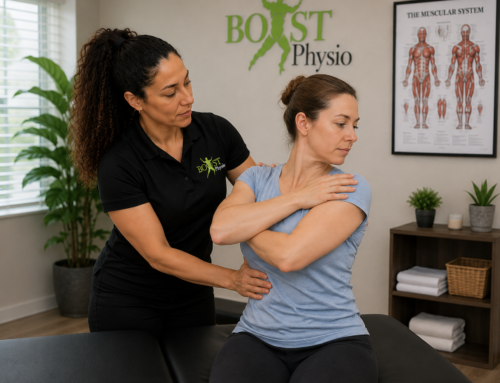
Sitting tall with your arms out to the sides, rotate through your upper back to reach one arm behind you while keeping your hips facing forward. This targets rotation and extension through the thoracic spine, the section of your back that cycling’s rounded, hands-on-the-bars position tends to stiffen up over time.
“Cyclists spend so much time in one shape, hips bent, back rounded forward, that the body starts to treat that as normal. These three moves take a few minutes and give your hips and upper back the opposite signal.” — Setareh Radfar, Chartered Physiotherapist, BOOST PHYSIO Swiss Cottage
Exercise 3: Split squat
With one foot forward and one back (elevating the rear foot on a step or chair makes this harder), lower straight down and drive back up, keeping most of your weight through the front leg. This is a genuinely useful exercise for cyclists because pedalling is fundamentally a single-leg action, one leg drives while the other recovers, over and over, and the split squat trains strength and control in that same single-leg pattern.
Research on the split squat has confirmed it’s a hip-dominant exercise, meaning it particularly builds strength through hip extension, and training unilaterally like this is a recognised way to build single-leg strength and address side-to-side imbalances that bilateral exercises like a regular squat can mask.3
Worth knowing before you start
A single stretch won’t undo months of adaptation to the riding position, and that’s normal. Research on hip flexor stretching has found that a single stretch produces a genuine, measurable improvement in range of motion immediately afterwards, but that improvement isn’t well maintained a couple of days later without repeating it.2 Consistency, not a one-off session, is what actually shifts things.
If you’re dealing with hip, lower back or knee pain that’s affecting your riding rather than just general tightness, it’s worth getting that properly assessed rather than assuming stretching alone will resolve it. Bike fit, pedalling mechanics and muscle imbalances can all play a part, and a physio assessment helps narrow down what’s actually driving it.
| # | Fact |
|---|---|
| 1 | The more time spent pedalling, the more the thoracic spine tends towards a flexed position, according to a systematic review of cyclists’ spinal posture.1 |
| 2 | Hip flexor flexibility deficits are recognised as a potential biomechanical risk factor affecting the trunk and lower limbs, not just the hip itself.2 |
| 3 | Pedalling is a single-leg action at any given moment, which is exactly why single-leg exercises like the split squat transfer so directly to cycling. |
| 4 | Split squats are hip-dominant, building hip extension strength more than a regular two-footed squat does.3 |
| 5 | A single stretching session genuinely improves flexibility in the short term, but the benefit fades within days without repeating it regularly.2 |
Watch the exercises
When cycling niggles need more than stretching
These exercises are a solid off-bike routine, but they’re not a substitute for an assessment if you’ve got pain that’s building session after session, or a niggle that’s changing how you ride. Saddle height, cleat position and bike fit all interact with the muscle and joint issues cycling can create, so getting the full picture matters more than guessing at stretches alone. Our guide to sports injury treatment covers what to expect from a proper assessment if you’d like to read more before booking in.
Our approach: every tool for your best recovery
At BOOST PHYSIO, we believe your best recovery comes from having every tool available, not relying on just one. That’s why our physiotherapists combine hands-on manual therapy with targeted exercise rehabilitation, tailored specifically to you and adjusted as you progress. It’s the thinking behind our promise: Your Best Recovery, Guaranteed.
At BOOST PHYSIO Swiss Cottage, based inside the Virgin Active Gym at the O2 Centre, we offer:
- ✓ Same day physiotherapy appointments
- ✓ Full access to the gym floor and pool for rehab exercises
- ✓ Treatment recognised by Bupa, AXA Health, Vitality and WPA
Book your assessment with Setareh online now, call 020 8201 7788 or WhatsApp us.
Frequently asked questions about exercises for cyclists
When’s the best time to do these, before or after a ride?
How long should I hold the hip flexor stretch for?
Do I need weights for the split squat?
Will these exercises make me a faster cyclist?
I get lower back pain after long rides, will this help?
[boost_locations_block]
[boost_locations_schema]
Written with Setareh Radfar, Chartered Physiotherapist at BOOST PHYSIO Swiss Cottage, and the BOOST PHYSIO team. This article is general guidance and is not a substitute for an individual physiotherapy assessment. References: (1) Muyor JM, et al, "Effects of Cycling on the Morphology and Spinal Posture in Professional and Recreational Cyclists: A Systematic Review", Sports Biomechanics, 2022. (2) Kiseljak D, Jelovica V, "Use of the Modified Thomas Test for Hip Flexor Stretching: What Are the Acute and Prolonged Effects?", Biomechanics, 2024;4(4):585-594. (3) Arakawa H, Nakashima H, Li X, Tanimoto M, "Rear Leg-derived Moment Contributes to Resistance Against Hip Extension in Bulgarian Split Squats", International Journal of Exercise Science, 2025;18(7):881-894.