
Quick answer: a standard front plank mostly trains the muscles running up and down the front of your body. It leaves the obliques and deep stabilisers at the sides of your spine, the ones that keep your pelvis level when you walk, run or stand on one leg, comparatively under-worked. The side plank targets that gap, and because most of us are stronger on one side without realising it, training both sides evenly is one of the simplest ways to take pressure off a tired lower back.
Why this matters
When you think "core exercise", what comes to mind? For most people it's sit ups, crunches or the plank. All useful, but they mostly train the muscles running up and down the front of your body. Your core isn't just your six pack. It's a corset of muscles wrapping right around your trunk, including the obliques and the deep stabilisers at the sides of your spine, and that side section is exactly what a standard front plank leaves under-trained.
That's where the side plank comes in, and it's one of the exercises our Crouch End team reaches for most often when someone's lower back needs more all-round support, not just a stronger front.
What the side plank actually works
The side plank works your obliques, the muscles along the side of your waist, along with the smaller stabilisers deep in your lower back and the muscles around your hip. Research using electromyography (EMG), which measures muscle activity directly, has recorded strong activation of the external obliques during the side plank, along with high activation of the gluteus medius on the leg that's bearing weight, the hip muscle that helps stop your pelvis dropping when you're on one leg.1
Together, these muscles help keep your pelvis level and your spine steady when you walk, run or simply stand on one leg to put your shoes on. Most of us are stronger on one side than the other without realising it. A side plank shows that up quickly, and training both sides evenly can take pressure off a lower back that's been quietly compensating.
"People are often surprised how much weaker one side is until they try it. That imbalance is usually invisible day to day, but it's exactly the kind of thing that can leave a lower back working harder than it should." — Finlay McDonald, Physiotherapist, BOOST PHYSIO Crouch End
How to do the side plank well
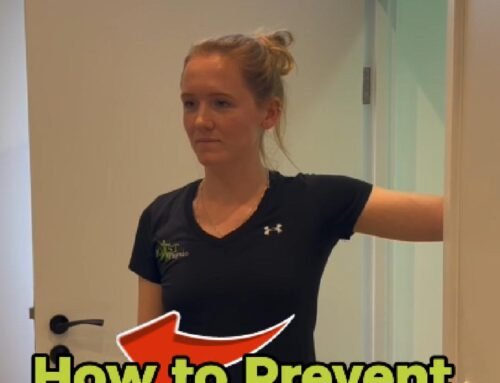
Fin, from our Crouch End branch, demonstrates and explains the exercise in the video below.
- Start small and build up - 15-20 seconds a side is a perfectly good starting point. If a full side plank on your forearm is too much to start with, drop to your knees instead.
- Stack your joints - shoulder, hip and ankle in one straight line, elbow directly under your shoulder.
- Lift from your waist, not your shoulder - think about pulling your hip up towards the ceiling rather than pushing up through your arm.
- Keep your hips forward - it's tempting to let them drift backward as you tire. Picture holding a straight line from your ear to your ankle.
- Breathe normally - holding your breath won't make you more stable, it just makes 20 seconds feel like a minute.
Worth knowing before you start
The side plank is a genuinely useful exercise, but it isn't necessarily where you should start if your back is currently painful. Research looking at core exercise tolerability in people with chronic low back pain found that the standard side plank was, by some distance, the hardest of the common core exercises to complete comfortably, with most participants unable to hold proper form for a working set. The knee-supported version wasn't treated as a lesser option in that study, it was the sensible progression route towards building up to the full version without unnecessary strain.2
That lines up with what we see in clinic. If you're in an acutely painful flare, or you've never done a side plank before, starting on your knees and progressing gradually is the safer, more sustainable route, exactly as the tips above suggest. If you're not sure which version is right for you, that's exactly the kind of thing a proper assessment sorts out quickly.
Five facts about the side plank
| # | Fact |
|---|---|
| 1 | The side plank targets the obliques and deep spinal stabilisers that a standard front plank largely leaves alone, rather than duplicating what the front plank already does. |
| 2 | It also activates the gluteus medius, the hip muscle that stops your pelvis dropping on the standing leg when you walk, run or climb stairs.1 |
| 3 | A timed side plank hold, tested on both sides, is a recognised way of screening trunk muscle endurance and spotting side-to-side imbalance, and is one of the tests physiotherapy researchers use to set normative benchmarks.3 |
| 4 | Most people are noticeably stronger on one side than the other, and often don't know it until they try holding both sides for time. |
| 5 | The full forearm version is genuinely demanding. Research in people with chronic low back pain found most couldn't hold good form on the standard version, which is exactly why the knee-supported variation is a sensible starting point, not a compromise.2 |
When back pain needs more than exercise
A well-built exercise like the side plank is a great addition to a healthy back routine, but it isn't a substitute for an assessment if your back pain is new, severe, spreading down a leg, or not settling with rest and gentle movement. Back pain has a lot of possible causes, and what helps one back won't always help another, so getting the right diagnosis first means you spend your time and effort on the exercises that will actually make a difference for you. Our guide to back pain treatment options covers what to expect from a proper assessment if you'd like to read more before booking in.
Our approach: every tool for your best recovery
At BOOST PHYSIO, we believe your best recovery comes from having every tool available, not relying on just one. That's why our physiotherapists combine hands-on manual therapy with targeted exercise rehabilitation, tailored specifically to you and adjusted as you progress. We've seen first-hand, time and again, that patients get the best and most lasting results when both are used together. It's the thinking behind our promise: Your Best Recovery, Guaranteed.
At BOOST PHYSIO Crouch End, we offer:
- ✓ Same day physiotherapy appointments
- ✓ Male and female clinicians
- ✓ Treatment recognised by Bupa, AXA Health, Vitality, WPA and Aviva
Book your assessment online now, call 020 8201 7788 or WhatsApp us.
Frequently asked questions about the side plank
Is the side plank safe if I already have back pain?
How long should I hold a side plank for?
What's the difference between a side plank and a regular plank?
I can't hold the full position on my forearm, does the knee version still work?
How often should I do side planks?
Written with Finlay McDonald, Physiotherapist at BOOST PHYSIO Crouch End, and the BOOST PHYSIO team. This article is general guidance and is not a substitute for an individual physiotherapy assessment. References: (1) Boren K, Conrey C, Le Coguic J, et al, "Electromyographic Analysis of Gluteus Medius and Gluteus Maximus During Rehabilitation Exercises", International Journal of Sports Physical Therapy, 2011;6(3):206-223. (2) Calatayud J, Escriche-Escuder A, Cruz-Montecinos C, Andersen LL, Pérez-Alenda S, Aiguadé R, Casaña J, "Tolerability and Muscle Activity of Core Muscle Exercises in Chronic Low-back Pain", International Journal of Environmental Research and Public Health, 2019;16(19):3509. (3) McGill SM, Childs A, Liebenson C, "Endurance Times for Low Back Stabilization Exercises: Clinical Targets for Testing and Training From a Normative Database", Archives of Physical Medicine and Rehabilitation, 1999;80(8):941-944.