
Frozen Shoulder vs Rotator Cuff Problems: How to Tell the Difference
Shoulder pain is one of the most common reasons people see our physiotherapists- and one of the most commonly misunderstood.
Two conditions in particular cause a significant amount of confusion, both for patients because the shoulder pain and limited movement / stiffness feels very similar: frozen shoulder (adhesive capsulitis) and rotator cuff problems.
They share a number of symptoms. Both can cause deep, aching shoulder pain. Both can disrupt your sleep. Both can make it difficult to reach overhead, fasten a seatbelt or get dressed in the morning. Yet they are fundamentally different conditions with different causes, different natural histories and – crucially – different treatments. Getting the diagnosis right from the start can save you months of unnecessary suffering.
In this guide, our expert physiotherapy team at BOOST PHYSIO explains what each condition is, how to spot the differences and what you should do if you think you might have either one.

What is Frozen Shoulder?
Frozen shoulder – known medically as adhesive capsulitis – is a condition in which the capsule surrounding the glenohumeral (shoulder) joint becomes inflamed and then progressively scarred and contracted. The capsule, which normally allows a wide and fluid range of movement, thickens and tightens, dramatically reducing the space within the joint and limiting movement in all directions.
Who gets frozen shoulder? It predominantly affects women between the ages of 40 and 60, and is significantly more common in people with diabetes, thyroid disorders and hyperlipidaemia. It affects around 2-5% of the general population, though the rate in people with diabetes is considerably higher. Importantly, it often develops spontaneously – without any preceding injury or obvious cause – which is one of the reasons it can be so confusing and alarming for patients.
The three stages of frozen shoulder
Frozen shoulder is well recognised to progress through three distinct phases, each with different characteristics:
- Stage 1 – The Freezing Stage: Increasing pain, often severe and worse at night. Movement begins to reduce. This stage is frequently misdiagnosed as a rotator cuff problem or general shoulder inflammation. Duration: 2-9 months.
- Stage 2 – The Frozen Stage: Pain may begin to ease somewhat but stiffness becomes the dominant problem. The shoulder feels locked. Simple tasks like reaching into a back pocket or fastening a bra become impossible. Duration: 4-12 months.
- Stage 3 – The Thawing Stage: Gradual spontaneous improvement in range of motion. This can take 12-24 months. Without appropriate physiotherapy, however, full recovery is not guaranteed and residual stiffness is common.

What is a Rotator Cuff Problem?
The rotator cuff is a group of four muscles and their associated tendons – the supraspinatus, infraspinatus, teres minor and subscapularis muscles- that surround and stabilise the shoulder joint, controlling its movement and keeping the ball of the humerus centred within the socket.
Rotator cuff problems exist on a spectrum and include:
- Rotator cuff tendinopathy: Degeneration or irritation of one or more of the tendons, often developing gradually through repetitive overhead activity, sustained poor loading patterns or age-related change.
- Subacromial impingement: Pain arising from compression of the rotator cuff tendons and bursa in the space beneath the acromion (the bony arch of the shoulder), particularly on overhead movement.
- Partial rotator cuff tear: A partial thickness tear of one or more tendons, which may be asymptomatic or cause significant pain and weakness depending on size and location.
- Full thickness rotator cuff tear: A complete tear through a tendon, often causing significant weakness. These can be acute (following a fall or sudden forceful movement) or degenerative (developing gradually over time).
Who gets rotator cuff problems? Rotator cuff disorders are the most common shoulder complaint seen by physiotherapists, accounting for more than half of all shoulder presentations according to a 2025 clinical practice guideline published in the Journal of Orthopaedic & Sports Physical Therapy. They are more common with age, with repetitive overhead activity (in work or sport) and following periods of sustained loading or trauma.
Why Frozen Shoulder and Rotator Cuff Problems Are Easily Confused
In the early stages particularly, the two conditions can be clinically very similar. Both produce:
- Pain deep in the shoulder – often a diffuse, aching quality
- Difficulty lifting the arm – reaching overhead, getting dressed, fastening a seatbelt
- Night pain – both conditions are notorious for disturbing sleep
- Progressive limitation – both tend to worsen rather than settle quickly
- Tenderness around the shoulder joint on palpation
A 2024 review highlighted that the clinical findings in early frozen shoulder can overlap substantially with subacromial pathology and rotator cuff tendinopathy – making misdiagnosis genuinely common, even in clinical settings. In the very early freezing stage of adhesive capsulitis, patients often present with what appears to be a routine rotator cuff problem. It is only as the condition progresses, and stiffness becomes the dominant feature, that the picture becomes clearer.
Adding further complexity, research published in the Clinical Shoulder and Elbow journal (2024) confirmed that frozen shoulder and rotator cuff tears frequently coexist in the same shoulder – meaning a patient can have both conditions simultaneously, which requires careful clinical assessment to unpick.
The Key Differences: How to Tell Them Apart
1. The passive movement test – the single most important distinction
This is the cornerstone of differential diagnosis and the test that BOOST PHYSIO clinicians apply in every shoulder assessment.
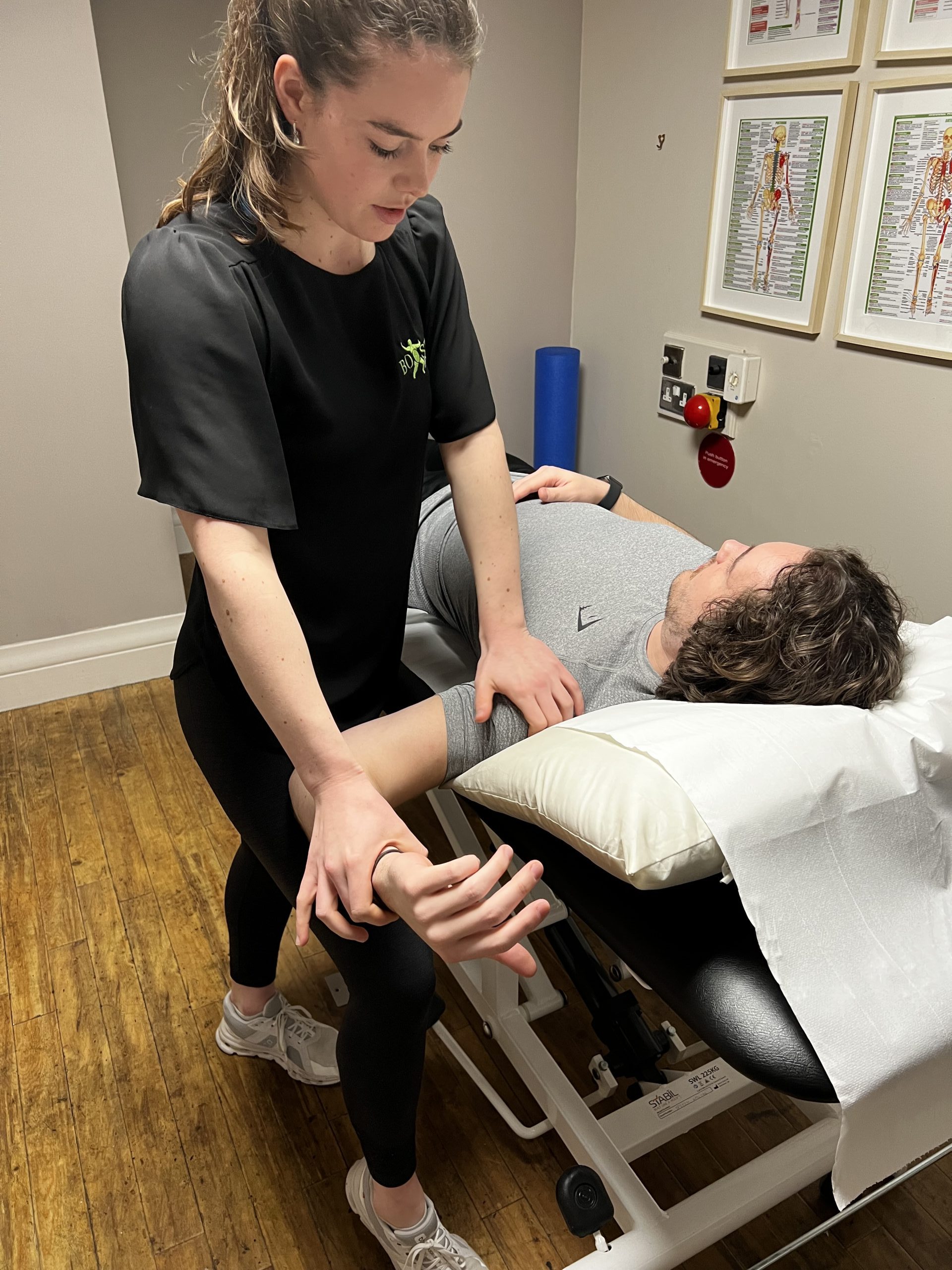
Passive range of motion refers to how far your shoulder can be moved when someone else moves it for you – rather than you moving it under your own muscle power.
In a rotator cuff problem, the difficulty lifting the arm is driven by pain or weakness in the muscles and tendons themselves. The joint capsule is not contracted. This means that while you may find it painful or difficult to lift your arm actively, a clinician can often move it considerably further for you passively. The range of movement is there – the problem is in the structure loading that movement.
In frozen shoulder, the joint capsule itself is contracted and scarred. When a clinician attempts to move the shoulder passively, the restriction is still present. The shoulder will not go – regardless of whether you are using your own muscles or not. This global restriction of both active AND passive movement is the defining clinical feature.
| The Key Test
Ask someone to gently lift your arm for you while you stay completely relaxed. If they can move it significantly more than you can on your own, a rotator cuff problem is more likely. If the arm is equally stuck whether you move it yourself or someone helps you – particularly if external rotation (turning the palm upward with the elbow at your side) is severely restricted – frozen shoulder is far more likely. |
2. The pattern of night pain
Both conditions can disturb sleep, but the character of the night pain differs in a clinically meaningful way.
With rotator cuff problems, night pain tends to be most provoked by lying directly on the affected shoulder. It is positional – changing position often gives some relief.
With frozen shoulder – particularly in the freezing stage – the night pain is far more constant and severe. Our patients with Frozen Shoulder describe being woken repeatedly, unable to find a comfortable position regardless of how they lie. A deep, constant, tooth-ache quality pain that is largely unrelated to shoulder position is characteristic. This severity of night pain, particularly in a patient aged 40-60 with no clear precipitating injury, should always raise strong clinical suspicion of frozen shoulder.
3. The pattern of onset
Rotator cuff problems typically have a more identifiable context: a history of repetitive overhead activity (painting, swimming, throwing sports, overhead manual work), a specific incident such as a fall or heavy lift, or a gradual worsening linked to activity. Pain is often most provoked by specific overhead movements.
Frozen shoulder classically develops spontaneously – often without any clear precipitating injury or overuse. Patients frequently report that it “just came on” without warning. This idiopathic onset, particularly alongside the risk factors of female sex, age 40-60 and diabetes or thyroid dysfunction, is an important diagnostic indicator.
4. The nature of weakness
Weakness is an important discriminator, though one that requires careful interpretation.
In rotator cuff problems, weakness is often a primary feature – particularly in larger tears. Patients may find they genuinely cannot lift the arm against resistance, or that strength drops away during movement. This is structural weakness from damaged tendons.
In frozen shoulder, weakness is typically secondary – a consequence of pain and disuse rather than primary structural failure of the tendons. That said, a 2024 study confirmed that patients with frozen shoulder do show measurable weakness of the internal rotators and elevators compared with the unaffected side, which can complicate the clinical picture.
5. Age, gender and medical history
Frozen shoulder has a strong demographic profile: predominantly women aged 40-60, with diabetes, thyroid disorders or hyperlipidaemia significantly increasing risk. It is unusual in younger patients without these risk factors.
Rotator cuff problems have a broader demographic but are particularly common in people over 50, those with a history of overhead sport or occupation and those with a previous shoulder injury.
Quick Comparison: Frozen Shoulder vs Rotator Cuff
| Frozen Shoulder | Rotator Cuff Problem | |
| What is it? | Inflamed, scarred joint capsule | Damaged tendons/muscles |
| Movement restricted? | Both active AND passive | Mainly active; passive often preserved |
| Night pain? | Severe – any position | Moderate – worse lying on shoulder |
| Onset? | Gradual, often no clear cause | Often linked to activity or incident |
| Weakness? | Secondary to pain and stiffness | Primary feature – often significant |
| Who gets it? | Women 40-60, diabetics, thyroid conditions | Overhead athletes, manual workers, over 50s |
| Timeline? | 12-24 months typical | Variable – weeks to months+ |
| Can they coexist? | Yes – makes diagnosis more complex | Yes – always assess both |
Why the Correct Diagnosis Matters So Much
This is not an academic distinction. The treatment approach for frozen shoulder and rotator cuff problems is fundamentally different – and getting it wrong can actively slow your recovery.
For rotator cuff tendinopathy and impingement: Treatment typically centres on progressive loading of the tendon, strengthening of the rotator cuff and scapular stabilisers, activity modification and – where appropriate – a subacromial corticosteroid injection to reduce inflammation and facilitate rehabilitation.
For frozen shoulder: The treatment approach must be tailored to the stage. In the acute freezing stage, aggressive stretching and heavy loading can be counterproductive and painful. The priority is pain management, gentle restoration of movement and – in many cases – an early intra-articular corticosteroid injection, which evidence suggests can shorten the duration of the condition when given early. In the frozen and thawing stages, hands-on joint mobilisation, guided stretching and progressive exercise become the priority.
Applying rotator cuff strengthening protocols to a patient in the acute freezing stage of adhesive capsulitis, or using passive mobilisation techniques appropriate for frozen shoulder on an acutely irritable rotator cuff, can worsen pain and delay recovery significantly.
| Important
A 2025 Clinical Practice Guideline specifically highlighted that ultrasound assessment – measuring the thickness of the coracohumeral ligament and glenohumeral capsule – is now an increasingly valuable tool for confirming frozen shoulder diagnosis when the clinical picture is ambiguous. At BOOST PHYSIO, our clinicians use detailed physical assessment and – where indicated – can advise on appropriate imaging to ensure you receive the right diagnosis from the outset. |
Self-Assessment: Three Simple Tests to Try at Home
These tests are not a replacement for a professional clinical assessment – but they can give you a helpful indication of which condition may be more likely.
Test 1 – The Passive Lift Test
Sit or stand and completely relax your arm. Ask a partner to very gently lift your arm forward and upward. If your arm moves considerably more than when you try it yourself, a rotator cuff problem is more likely. If the arm is equally stuck even with help, frozen shoulder is more likely.
Test 2 – The External Rotation Test
Keep your elbow bent at 90 degrees and tucked into your side. Ask your partner to very gently try to rotate your forearm outward (turning your palm upward). In frozen shoulder, this external rotation is almost always severely restricted – even passively. In rotator cuff problems, this movement is often preserved or only mildly limited.
Test 3 – The Night Pain Test
Consider the character of your night pain. Is it only bad when you lie directly on the shoulder, and does changing position help? (More suggestive of rotator cuff.) Or is it a constant, deep ache that wakes you regardless of position and is difficult to relieve? (More suggestive of frozen shoulder.)
| Important disclaimer
These self-tests are for general guidance only and should not replace a professional clinical assessment. Both conditions can present atypically, and they can coexist in the same shoulder. If you have persistent shoulder pain lasting more than 2-3 weeks, please book a physiotherapy assessment. |
Treatment Options at BOOST PHYSIO
For frozen shoulder
- Hands-on joint mobilisation techniques to restore capsular mobility
- Stage-appropriate exercise prescription – from pain management to progressive strengthening
- Patient education on the natural history and realistic timelines
- Liaison with your GP or consultant regarding intra-articular corticosteroid injection, which evidence supports as effective in reducing the duration of the freezing stage
- Hydrotherapy for appropriate patients
- Extracorporeal shockwave therapy (ESWT) where indicated
For rotator cuff problems
- Comprehensive rotator cuff and scapular stabiliser strengthening programmes
- Hands-on soft tissue therapy and joint mobilisation
- Activity and load management advice
- Subacromial corticosteroid injection advice and GP liaison
- Sports-specific rehabilitation for return to sport
- Post-operative rehabilitation following rotator cuff repair
Frequently Asked Questions about Frozen Shoulder and Rotator Cuff Problems:
When Should You See a Physiotherapist?
You should seek a physiotherapy assessment if:
- Shoulder pain has persisted for more than 2-3 weeks without improvement
- You are waking at night with shoulder pain
- You are finding everyday tasks – dressing, driving, reaching – increasingly difficult
- Your shoulder has been progressively stiffening over weeks or months
- You have had a shoulder injury and want to know the extent of damage
- You have been told you have a rotator cuff problem but are not improving with treatment
Early assessment and accurate diagnosis is the single most important step. Both frozen shoulder and rotator cuff problems respond significantly better to treatment when addressed early. Waiting months to “see if it settles” – particularly with frozen shoulder – allows the condition to advance to a stage that is harder and slower to treat.
Can frozen shoulder and a rotator cuff problem happen at the same time?
Yes. Research published in 2024 confirmed that frozen shoulder is frequently accompanied by concurrent rotator cuff pathology. This coexistence makes accurate clinical assessment even more important, as treating one condition while missing the other will delay your recovery.
Do I need an MRI scan to diagnose my shoulder problem?
Not always. The majority of shoulder diagnoses are made clinically through a thorough history and physical examination. However, ultrasound or MRI may be recommended if the clinical picture is unclear, if conservative treatment is not producing expected results or if surgical management is being considered. A 2025 clinical guideline confirmed that ultrasound has become an increasingly useful tool for differentiating frozen shoulder from other shoulder conditions.
How long does frozen shoulder last?
Without treatment, frozen shoulder can last between 18 months and 3 years. With appropriate physiotherapy – including hands-on mobilisation, guided exercise and – where suitable – corticosteroid injection, this timeline can be significantly reduced. Outcomes are considerably better when treatment begins in the early freezing stage.
How long does a rotator cuff problem take to recover?
This depends on the nature of the problem. Rotator cuff tendinopathy and impingement typically respond well to physiotherapy over 6-12 weeks. Partial tears may take longer. Full thickness tears that require surgical repair have a rehabilitation timeline of 4-6 months or more, with physiotherapy playing a central role throughout.
Is it safe to exercise with frozen shoulder?
Exercise is important – but must be stage-appropriate and guided by a physiotherapist. In the acute freezing stage, aggressive stretching and heavy loading can worsen pain. In the frozen and thawing stages, progressive mobility work and strengthening are essential to optimise recovery. Self-managed stretching without professional guidance is a common cause of prolonged symptoms.
Get Expert Shoulder Assessment at BOOST PHYSIO
BOOST PHYSIO’s expert physiotherapy team assesses and treats both frozen shoulder and rotator cuff conditions across all 10 of our London and Hertfordshire clinics. We offer same-day appointments from 8am to 9pm, including weekends, so you don’t have to wait to get answers.
Our physiotherapists use detailed clinical assessment – including passive and active range of motion testing, strength assessment and specialist orthopaedic tests – to give you an accurate diagnosis and a clear, personalised treatment plan from your very first appointment.
| Book Your Assessment Today
020 8201 7788 | boostphysio.com | Same-day appointments available Insurance-friendly: Bupa, AXA Health, Vitality, WPA | Affordable self-pay Your Best Recovery – Guaranteed. |
References and Research
This blog post draws on the following recent clinical research and guidelines:
- Journal of Orthopaedic & Sports Physical Therapy (2025): Rotator Cuff Tendinopathy Clinical Practice Guideline – diagnosis, non-surgical management and rehabilitation.
- Korean Annals of Rehabilitation Medicine (2025): Clinical Practice Guidelines for Diagnosis and Non-Surgical Treatment of Primary Frozen Shoulder.
- Eurasian Journal of Medicine (2026): Quantitative MRI evaluation of coracohumeral ligament and inferior glenohumeral capsule thickening in adhesive capsulitis.
- Clinical Shoulder and Elbow (2024): Concomitant rotator cuff tear with frozen shoulder – diagnostic criteria and imaging stratification.
- European Journal of Orthopaedic Surgery & Traumatology (2024): A comprehensive scoring system for the diagnosis and staging of adhesive capsulitis.
- NCBI StatPearls (updated March 2025): Adhesive Capsulitis – updated clinical review.
BOOST PHYSIO blog content is written and reviewed by our clinical team. It is intended for patient education and does not constitute medical advice. Always seek a professional assessment for shoulder pain lasting more than 2-3 week