Skip to content
  • WhatsApp Us
  • 020 8201 7788
Boost Physio Logo Boost Physio Logo Boost Physio Logo
  • Services
    • Back / Neck
      • Back Pain
      • Slipped Disc
      • Pinched Nerve
      • Neck Pain
      • Posture / Scoliosis
      • Headache Physio
    • Knee Problems
      • Knee Ligament
      • Sports Injuries
      • ACL
      • Runners Knee
      • Kneecap
      • Knee Replacement
    • Hip
      • Hip Replacement
      • Hip Impingement
      • Post-Op Rehab
    • Ankle / Foot
      • Sprained Ankle
      • Achilles Tendon
      • Plantar Fasciitis
      • Taping
      • Sports Injury
    • Shoulder / Elbow / Hand
      • Shoulder Pain
      • Stiff Shoulder
      • Rotator Cuff
      • Tennis Elbow
      • Thumb Pain
    • Mummy MOT®
    • Vertigo, Dizziness, BPPV
    • Specialist Services
      • Women’s Health
      • Sports Injury Clinic London
      • Hypermobility / EDS
      • Hydrotherapy
      • Arthritis Treatment
  • Reviews
  • Locations
    • Kentish Town- NW5
    • Crouch End- N8: Opening Soon!
    • Hampstead Garden Suburb- NW11
    • Borehamwood- WD6
    • East Finchley- N2
    • Elstree- WD6
    • Hampstead- NW3
    • Hendon- NW4
    • Kensington- W8
    • Mill Hill- NW7
    • Muswell Hill- N10
    • Swiss Cottage- NW3
    • Swiss Cottage Leisure Centre- NW3
  • Team
  • About
    • Why Us
    • Conditions
    • Treatments
    • Rates
    • Blog/News
    • Careers
  • Contact Us
  • Book OnlineNow

Tennis Elbow Physio Exercises To Help

Previous Next
Tennis Elbow Physio Exercises To Help
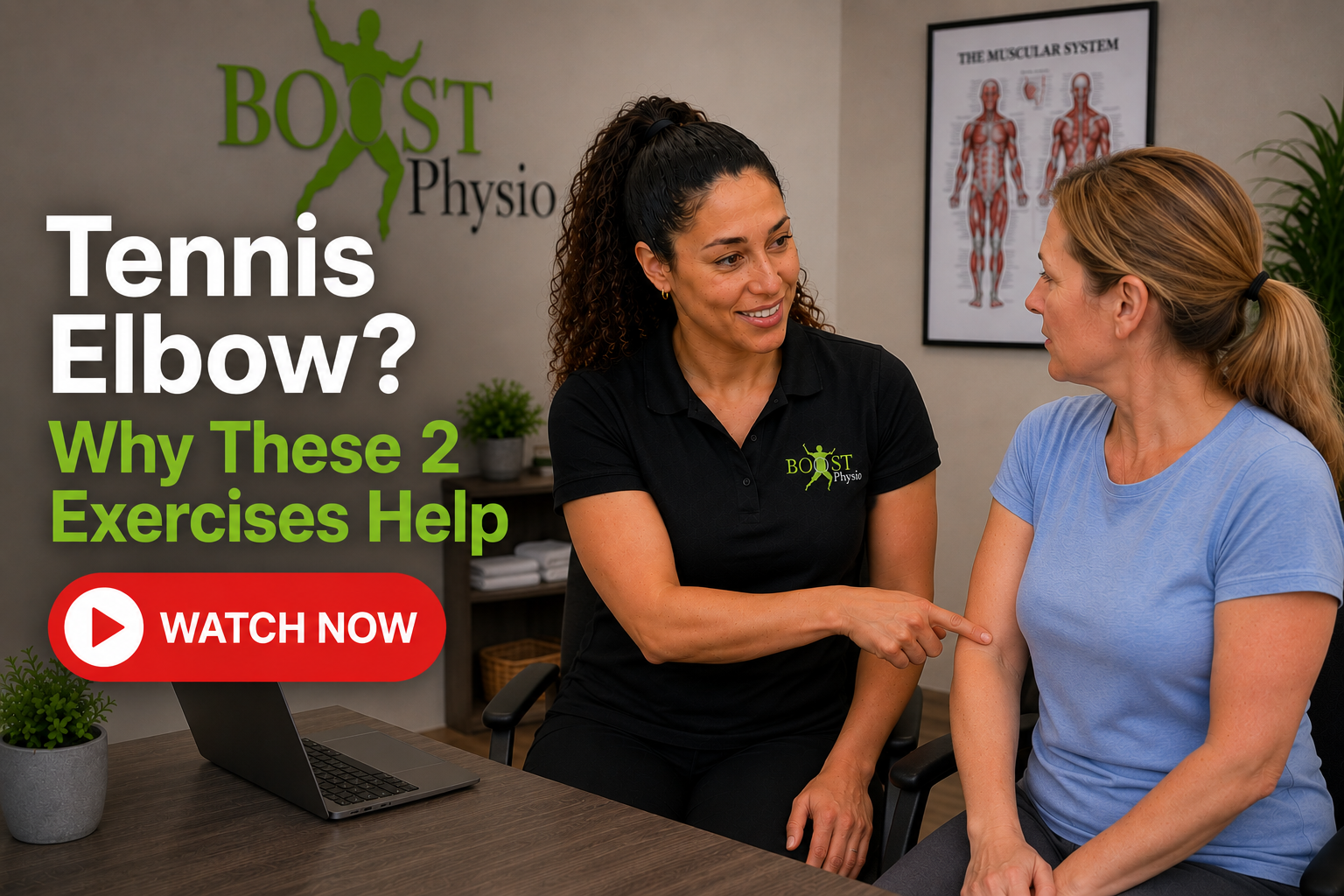
  • View Larger Image Physio exercises to help tennis elbow
 

Tennis Elbow: Why Rest Alone Won’t Fix It

And the counter-intuitive science that explains why loading your tendon is the key to recovery

If your elbow has been aching for weeks – or months – you’re not alone. Tennis elbow is one of the most common overuse injuries we see at BOOST PHYSIO, affecting everyone from office workers and keen gardeners to gym-goers and, yes, the occasional tennis player.


Most people try the same 2 things: rest it or push through it, hoping it settles. And for many, neither of those approaches gives lasting relief.


The reason? What your tendon actually needs to heal is almost the opposite of what feels intuitive.

What is tennis elbow?

Tennis elbow (lateral epicondylalgia) is an overuse injury affecting the tendons on the outside of the elbow – specifically where the wrist extensor muscles attach to the bony prominence known as the lateral epicondyle. Repetitive gripping, lifting or twisting movements cause tiny microtears in the tendon over time, leading to pain, weakness and that tell-tale tenderness on the outer elbow.


It’s most commonly seen in people aged 35-55. Despite the name, fewer than 5% of cases are related to tennis – you’re just as likely to develop it from typing, decorating, gardening or repeated lifting.

The counter-intuitive science: why an overuse injury needs exercise

Here is where most people get stuck – and understandably so.

If tennis elbow is caused by overuse, surely the answer is to stop using it? 

It feels completely logical. You’ve been gripping, lifting and repeating the same movements until something breaks down. Of course the answer is to rest. Give it a break. Let it heal.

Except tendons don’t work like that. And understanding why changes everything.

Tendons are not muscles

Muscles have a rich blood supply. When you strain a muscle, blood rushes in carrying oxygen and nutrients, inflammation does its job, and healing is relatively rapid. Tendons are different. Their blood supply is sparse – by design, because tendons need to be dense and strong rather than soft and pliable. This means that when a tendon becomes irritated or develops microtears, passive rest doesn’t bring the healing response you’d expect.


Rest reduces pain temporarily – but it doesn’t fix the underlying tendon. And the longer you rest, the more the tendon deconditions: it loses stiffness, loses tolerance to load, and becomes even more vulnerable when you return to normal activity. For many people, several weeks of rest followed by a return to work or sport triggers a flare-up that feels worse than the original injury. This is why.


Rest reduces pain – but it doesn’t repair the tendon. Load does.

Click to Watch Katy Demonstrate 2x Loading Exercises

What tendons actually respond to: mechanical load

Tendons are mechanosensitive – they detect and respond to physical force. When a tendon is loaded appropriately, the cells within it (called tenocytes) are stimulated to produce new collagen – the structural protein that makes tendons strong and resilient. This process of load-driven remodelling is how tendons repair themselves and adapt to demand.


Without that load stimulus, the process doesn’t happen. The tendon stays in a state of disorganised, weakened tissue – painful and fragile, but not healing.


The key word is appropriate. Too much load too soon is what caused the problem in the first place. Too little load means the tendon never gets the signal it needs to remodel. The goal of rehabilitation is to find the right loading level – enough to stimulate healing, not enough to re-irritate.


In short: the loading paradox

Overuse caused the problem – but controlled, progressive loading is what fixes it.

Rest relieves symptoms short-term – but prolongs recovery long-term.

The difference between harmful load and healing load is not the exercise itself – it’s the type, dose and progression.


When exercises aren’t enough: shockwave therapy for stubborn tennis elbow

For some people, tennis elbow becomes a genuinely persistent problem- pain that lingers for months despite doing the right exercises, having physiotherapy and modifying activity. If that sounds familiar, shockwave therapy (ESWT) may be the next step.

Shockwave can help trigger a renewed healing response in tissue that has become stuck in a chronic, non-healing state. It works by stimulating tenocyte activity, promoting new collagen production and improving blood flow to an area that is notoriously poorly vascularised.

👉 Click here to watch Annie examine someone with tennis elbow and use Shockwave as a treatment.

WhatsApp Us Your Questions Now!

New Clinic Now Open In Kentish Town- NW5

We are thrilled to announce that our newest branch is now open, moments from Parliament Hill Lido, Swains Lain Highgate, Dartmouth Park and Highgate Ponds.


Whether you are a runner on Parliament Hill, a regular swimmer in the Highgate Ponds or a local resident in this Highgate, Dartmouth Park, Gospel Oak, Tufnell Park area- our newest branch of BOOST PHYSIO is on your door-step.  Learn more here.

Book Online Now


Message us on WhatsApp now your questions or email, so that we can help you right away.


Best wishes

Steven Berkman and The BOOST PHYSIO Team

Click to Call Us Now


By Steven Berkman|2026-06-04T03:40:07+00:0004/06/2026|Exercise, Tennis Elbow|

Related Posts

Morning Low Back Stretch Routine

Morning Low Back Stretch Routine

04/06/2026
Marathon Runners: Get Race-Ready Promo

Marathon Runners: Get Race-Ready Promo

15/02/2026
How to make getting out the car easier

How to make getting out the car easier

09/02/2026
How to Help Ankle Stiffness and Pain

How to Help Ankle Stiffness and Pain

18/11/2025
Is Your Grip Strength Age Appropriate?

Is Your Grip Strength Age Appropriate?

26/06/2025
Action Plan To Improve Grip Strength

Action Plan To Improve Grip Strength

19/06/2025

Our musculoskeletal experts love helping people overcome pain, injury and surgery. We have helped over 38,000 people feel fantastic, faster. Start your recovery today. 13 physiotherapy clinics near me in NW London, North London and WD6 Hertfordshire for convenient expert physio nearby.

Contact Information

  • 020 8201 7788
  • Message Boost Physio on WhatsApp
  • info@boostphysio.com
  • Same Day Appointments
    Mon-Thurs 8am-9pm
    Fri 8am-3pm
    Sat & Sun 9am-4pm

  • Correspondence:

    16 Parson Street, Hendon, NW4 1QB

Useful Links

  • About
  • Team
  • Locations
  • Rates
  • Reviews
  • Treatments
  • Conditions
  • Blog/News
  • Contact Us
  • Careers

Locations

  • Kentish Town- NW5
  • Crouch End- N8: Opening Soon
  • East Finchley- N2
  • Hampstead- NW3
  • Hendon- NW4
  • Elstree- WD6
  • Kensington-W8
  • Mill Hill- NW7
  • Borehamwood- WD6
  • Muswell Hill- N10
  • Swiss Cottage- NW3
  • Hampstead Garden Suburb- NW11
  • Swiss Cottage Leisure Centre- NW3

Copyright © BOOST PHYSIO Limited | All Rights Reserved | Cookie Policy

✔️ Book Online

Page load link
We use cookies to ensure that we give you the best experience on our website. If you continue to use this site we will assume that you are happy with it.
Go to Top