


What Doctors And Surgeons Say

“My patients have been very well looked after by the professional team at BOOST PHYSIO.”

“When referring patients to BOOST PHYSIO I know I can rely on professional evidence-based, high quality treatment from friendly therapists.”

“BOOST PHYSIO have always taken good care of my patients.”
“Very professional clinic. Would highly recommend BOOST PHYSIO.”

“BOOST Physio have been a fantastic resource for my patients, particularly those with complicated problems or those who are going through post-op rehab. They are highly skilled, and really help motivate patients to get back to being active. An all-round fab team!”
“Fantastic physios. BOOST have always looked after me well.”
“BOOST PHYSIO has provided a timely, efficient and highly professional service to many of my patients, which has helped them in their post-op recovery back to full function.”
“My shoulder is completely better.”
“I have always found BOOST to be extremely helpful and efficient when dealing with my patients.”

“BOOST PHYSIO offer an exceptional service for my patients. With several locations across North London, and great communication, it’s great to receive positive patient feedback.”
Physiotherapy for Young People and Adolescents
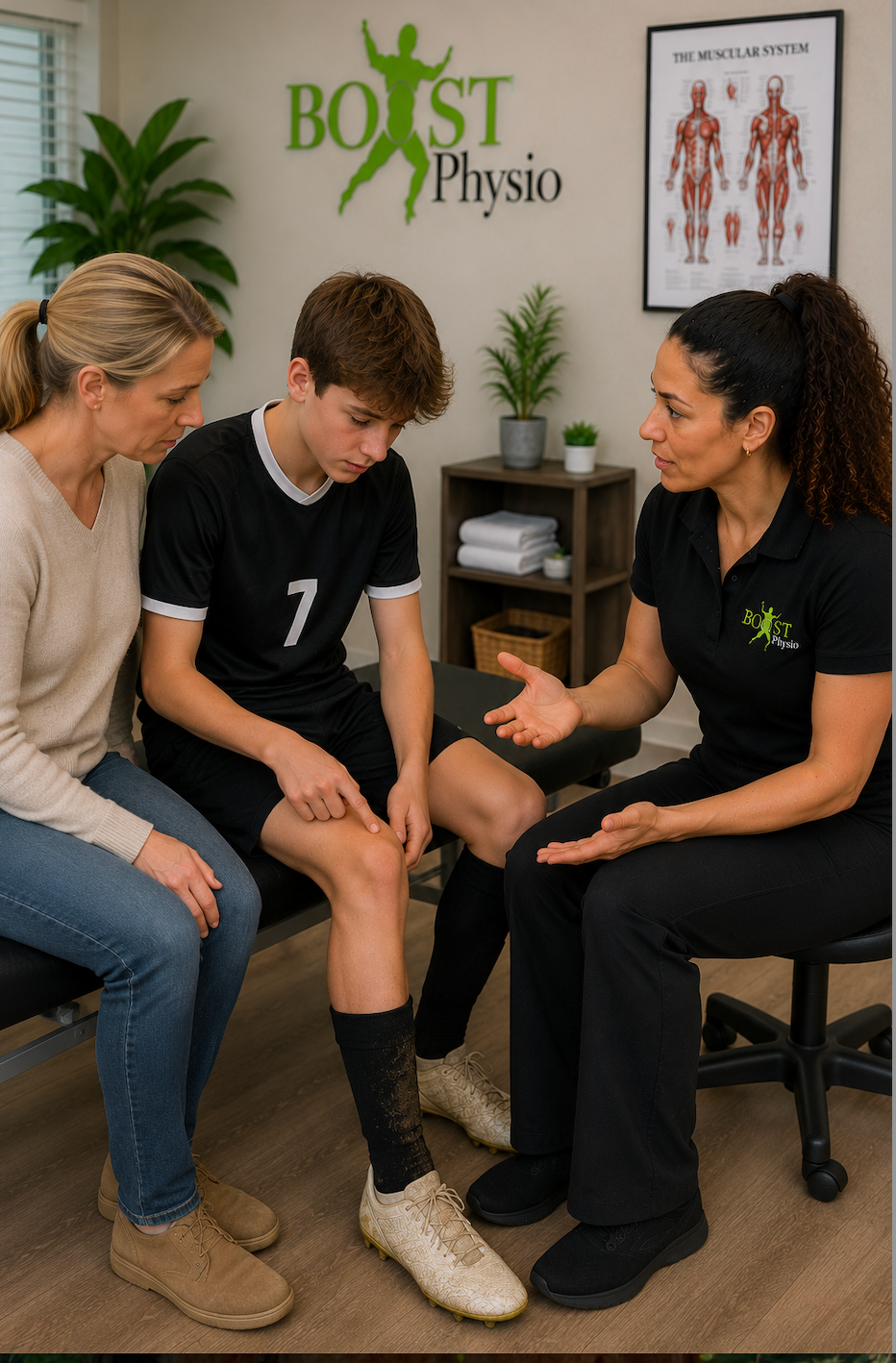
Expert MSK physiotherapy for children and teenagers aged 9-18 across North London and Hertfordshire. Growing bodies need specialist care - and we understand that.
If your child or teenager is struggling with knee pain, back pain, a sports injury or a condition related to their growth, physiotherapy can make a real difference - often quickly. At BOOST PHYSIO, we treat young people aged 9 and upwards across all of our clinics. Our experienced team understands the specific challenges of a growing body, and we tailor every treatment to the individual - whether your child is a competitive athlete, a keen school sports player, or simply a young person in pain who wants to get back to doing the things they love.
No GP referral is needed. Same-day appointments are frequently available.
Book an Appointment Online Call Us: 020 8201 7788
Why Young People Need Specialist Physiotherapy
Adolescence is one of the most physically demanding periods of life. The body is growing rapidly, bones are lengthening, muscles and tendons are being stretched, and many young people are simultaneously pushing themselves hard in sport and physical activity. This combination creates a unique set of vulnerabilities that simply do not exist in adults.
Conditions that affect adolescents are often very different from adult presentations of the same symptoms. A teenager with knee pain is far more likely to have a growth-related condition such as Osgood-Schlatter disease than the knee degeneration seen in older adults. A young person with back pain may have scoliosis - a spinal curvature requiring a completely different approach to the chronic postural back pain common in adults. And a child with hypermobility may be struggling with joint instability and fatigue that is entirely misunderstood by those around them.
At BOOST PHYSIO, our clinicians are experienced in recognising these differences and treating them appropriately. We do not simply apply adult physiotherapy protocols to young patients. We take the time to understand where your child is in their development, what they are doing physically, and what realistic recovery looks like for them.
Conditions We Treat in Young People
Osgood-Schlatter Disease
Osgood-Schlatter disease is one of the most common causes of knee pain in active young people, typically affecting those aged 10-15. It causes pain and tenderness just below the kneecap at the bony prominence on the upper shin (the tibial tubercle), where the patellar tendon attaches. It is caused by the repeated pulling of the patellar tendon on this growth plate during activity, and is particularly common in young footballers, runners and dancers who are going through a growth spurt.
Pain is typically worse during and after exercise and the affected area is often visibly swollen and tender to the touch. In some cases both knees are affected. Although Osgood-Schlatter generally settles once growth is complete, leaving the condition unmanaged can mean months of unnecessary pain and reduced activity. Physiotherapy helps by reducing load through the affected area, addressing muscle imbalances - particularly tight quadriceps - prescribing appropriate exercises, and advising on activity modification to keep your child active without making things worse.
Sinding-Larsen-Johansson Syndrome
Often confused with Osgood-Schlatter disease, Sinding-Larsen-Johansson syndrome (SLJ) affects a slightly different part of the knee - the lower pole of the kneecap itself, rather than the tibial tubercle. It is caused by traction stress on the patellar tendon at its attachment to the bottom of the patella, again related to rapid growth and high activity levels. Pain is felt at the very bottom of the kneecap and is typically worse when running, jumping or climbing stairs.
Like Osgood-Schlatter disease, SLJ responds well to physiotherapy. Load management, targeted strengthening and flexibility work, and structured return-to-sport guidance allow most young people to continue participating in sport throughout treatment with the right modifications in place.
Sever's Disease (Heel Pain)
Sever's disease - properly known as calcaneal apophysitis - is the most common cause of heel pain in children and young adolescents, and one of the conditions we treat most frequently in this age group. Despite the word "disease," it is not a serious or dangerous condition. It is a growth-related overuse injury affecting the calcaneal growth plate - the area at the back of the heel bone where the Achilles tendon inserts - and it is entirely self-limiting, meaning it resolves once the growth plate matures and closes.
It typically affects children and young adolescents aged 8 to 15, most commonly during or just after a growth spurt or at the start of a new sports season. It is particularly prevalent in young footballers, runners, gymnasts and basketball players. Pain is felt at the back and underside of one or both heels, is worse during and after activity - particularly running and jumping - and typically eases with rest. A classic sign is the child walking on their toes to avoid putting pressure through the heel. In some cases both heels are affected simultaneously.
The underlying mechanism is straightforward: as the long bones of the leg lengthen rapidly during a growth spurt, the soft tissues - particularly the calf muscles and Achilles tendon - can temporarily struggle to keep pace, creating tightness and increased traction stress on the growth plate with every step. High activity loads compound this further.
Physiotherapy is the gold-standard treatment for Sever's disease. A 2024 systematic review confirmed that conservative physiotherapy interventions - including targeted calf and Achilles stretching, dorsiflexion strengthening, manual therapy to the calf and ankle, and heel lifts or orthotics where appropriate - consistently reduce pain and restore function. Importantly, complete rest is rarely necessary or beneficial. Our physiotherapists will assess your child's biomechanics, activity levels and footwear, identify any contributing muscle tightness or weakness, and develop a plan that keeps your child as active as safely possible while the growth plate settles. Most young people with Sever's disease respond well within a few weeks of starting treatment.
Scoliosis
Scoliosis is a sideways curvature of the spine. The most common form - adolescent idiopathic scoliosis - typically develops during the growth spurt of early puberty, and is more common in girls than boys. Mild scoliosis may cause few or no symptoms, but as curvature progresses it can lead to visible asymmetry of the shoulders, ribcage or hips, back pain, reduced flexibility and, in more significant cases, breathing difficulties.
Early identification is important. If you or your child's school has noticed any uneven shoulders, a prominent shoulder blade, or one hip appearing higher than the other, physiotherapy assessment is a sensible first step. Our physiotherapists will assess posture and spinal alignment, advise on appropriate exercises, and work alongside any consultant or orthopaedic team involved in your child's care. Physiotherapy-based exercise programmes (known as Schroth-based or SEAS approaches) have strong evidence supporting their use in adolescent scoliosis, both as a standalone intervention and alongside bracing.
Posture Problems and "Tech Neck"
Poor posture has become increasingly common in young people, driven by the enormous amount of time spent hunched over phones, tablets and laptops - particularly in the post-lockdown era where screen time increased dramatically. "Tech neck" - the forward head posture and rounded shoulders that develop from prolonged device use - places significant and sustained load on the neck and upper spine, and is a growing cause of neck pain, headaches, upper back tension and shoulder problems in teenagers.
Poor posture during growth can also have longer-term consequences for spinal development. Physiotherapy can assess postural habits, identify muscle imbalances and weaknesses driving the problem, and provide a practical, manageable programme to help your child develop stronger, healthier posture. We also advise on ergonomics for studying and screen use - something that can make a significant difference quickly.
Hypermobility and Joint Laxity
Joint hypermobility - the ability to move joints beyond the normal range of motion - is very common in children and adolescents, and is significantly more prevalent in this age group than in adults. For many young people it causes no problems at all. However, for some it leads to joint pain, repeated sprains, fatigue, poor proprioception (the body's sense of where it is in space) and reduced exercise tolerance, particularly during growth spurts when the body is least coordinated.
Hypermobility exists on a spectrum. At one end is simple generalised hypermobility causing occasional joint discomfort. At the other end are hypermobility spectrum disorders and hypermobile Ehlers-Danlos syndrome (hEDS), which require careful, specialist management. Our clinicians are experienced in assessing and treating hypermobility across the full spectrum, providing targeted strengthening to build the joint stability and proprioception that hypermobile young people often lack. We take a careful, graded approach that respects the individual's energy levels, avoids overloading vulnerable joints, and builds genuine functional strength over time.
See our dedicated Hypermobility and EDS page for more detail.
Fractures and Post-Injury Rehabilitation
Young people are active, and injuries happen. When they do, getting rehabilitation right from the start makes a real difference to how quickly and completely your child recovers. Following a fracture, once clearance has been given by the treating orthopaedic team to begin physiotherapy, skilled rehabilitation is essential to restore range of movement, rebuild strength, address the muscle wasting that accumulates during immobilisation, and guide a safe return to full activity and sport.
We work with all types of fracture rehabilitation in young people - from common wrist and forearm fractures, ankle and foot fractures, to stress fractures in young runners and dancers. We also see many young people following growth plate injuries (Salter-Harris fractures), which require particular care given that the growth plate is the most vulnerable point in a developing bone. Our physiotherapists will liaise with your orthopaedic team and follow any specific post-operative or post-fracture protocols as required.
Sports Injuries in Young Athletes
Active young people sustain a wide range of sports injuries - from ankle sprains, hamstring strains and shin splints to more serious injuries such as ACL tears, shoulder dislocations and stress fractures. Young athletes also face specific overuse injury risks that adults do not, because their skeletons are still developing and growth plates remain open and vulnerable.
Our approach to sports injuries in young people is to assess the whole picture - not just the injured tissue but the training load, technique, growth phase and physical development of the individual. We aim to get your child back to sport as quickly as is safe, with a structured, stage-based return-to-sport programme that minimises the risk of re-injury. We also work with parents and coaches to ensure training loads are appropriate and recovery is properly built into the schedule.
Common sports injuries we treat in young people include:
- Ankle sprains and ligament injuries
- Hamstring and quadriceps strains
- Shin splints (medial tibial stress syndrome)
- Patellofemoral pain (anterior knee pain)
- Shoulder instability and labral injuries
- ACL injuries and post-operative ACL rehabilitation
- Stress fractures in runners, gymnasts and dancers
Back Pain in Young People
Back pain in teenagers and young people is more common than many parents realise, and it should not simply be dismissed as growing pains. While the causes are often different from those seen in adults, adolescent back pain can be persistent and genuinely limiting. Common causes include Scheuermann's kyphosis (a structural rounding of the thoracic spine during growth), spondylolysis (a stress fracture in the lumbar vertebra more common in young athletes who perform extension-based sports such as gymnastics, fast bowling and rowing), postural back pain from prolonged sitting, and non-specific low back pain related to muscle weakness and inactivity.
A thorough assessment will identify the specific cause and guide the most appropriate treatment, which might include manual therapy, targeted strengthening, posture retraining and advice on activity modification.
What to Expect at Your Child's First Appointment
We understand that coming to physiotherapy can feel daunting for young people, particularly if they have not been before. Our clinicians are experienced at putting teenagers at ease and making the assessment and treatment process as straightforward and comfortable as possible.
At the first appointment, your child's physiotherapist will:
- Take a detailed history - asking about the problem, when it started, what makes it better or worse, and what activity and sport your child does
- Carry out a physical assessment relevant to the presenting problem - this may include observing movement, testing strength and flexibility, and assessing posture
- Explain what they have found in clear, straightforward language - to both your child and you as the parent or guardian
- Begin treatment in the same session where appropriate
- Provide a clear plan for recovery, including any exercises to do at home and guidance on activity and sport in the meantime
We are happy for parents to be present throughout the appointment. For teenagers who prefer some independence, we can also see them with a parent or guardian waiting nearby - whatever works best for your family.
Why Choose BOOST PHYSIO for Your Child or Teenager?
- Over 1,000 five-star Google reviews - trusted by thousands of families across North London and Hertfordshire
- Same-day appointments - no waiting when your child is in pain and missing sport or school
- Hands-on manual therapy - we do not just give exercises and send you home; we treat
- Average of five treatments to resolve a problem - efficient, effective care that gets results
- No GP referral required - book directly online or by phone
- Clinics across London and Hertfordshire - always a convenient location nearby
- Recognised by major insurers - BUPA, AXA Health, Vitality and WPA
Frequently Asked Questions
Ready to get your child or teenager the help they need?
Do not let pain hold your young person back. Book today - no GP referral needed, same-day appointments frequently available across all our clinics.
Book Online Now 020 8201 7788


Fees & Insurance
✅ 30 min Appointments from: £80
✅ 60min Appointments from £120
A 30min appointment enables us to fully assess your knee issue. If you wish to have full treatment at the same visit and you are self-paying, book a 60min appointment. For insured patients we only provide 30min appointments.
We are recognised by major medical insurers:
✅ BUPA
✅ AXA
✅ WPA
✅ Vitality
✅ AVIVA
