Ready to sort out your vertigo?
Physio to help you today
Being dizzy from vertigo and Benign Paroxysmal Positional Vertigo (BPPV) is VERY distressing, leading to feeling of sickness and difficulty moving confidently. With specific treatments (eg Epley Manoeuvre) dizziness symptoms can often be resolved and improved quickly.


Vertigo & BPPV Treatment
Expert physiotherapy for dizziness, vertigo and Benign Paroxysmal Positional Vertigo (BPPV) across North London and Hertfordshire.
If you have been woken by a sudden, disorienting spin when you roll over in bed, or felt the room tilt every time you look up or bend forward, you may be experiencing BPPV - one of the most common causes of vertigo. The good news is that it is also one of the most treatable. At BOOST PHYSIO, our experienced clinicians have helped many patients recover from BPPV and dizziness - often in just one or two sessions.
You do not need a GP referral. Same-day appointments are frequently available across our clinics in North London and Hertfordshire.
Book an Appointment Online Call Us: 020 8201 7788
What Is BPPV?
BPPV stands for Benign Paroxysmal Positional Vertigo. Breaking that down:
- Benign - it is not caused by anything serious or life-threatening
- Paroxysmal - it comes on suddenly and in brief episodes
- Positional - it is triggered by changes in head position
- Vertigo - the sensation that you or the room around you is spinning
BPPV occurs when tiny calcium carbonate crystals - known as otoconia, or sometimes called "ear crystals" - become dislodged from their normal position in the inner ear and migrate into the semicircular canals. These canals are responsible for detecting rotational movement of the head. When the crystals are present, even small head movements generate incorrect signals to the brain about where the body is in space, producing the distinctive spinning sensation of vertigo.
BPPV is the most common cause of vertigo seen in physiotherapy practice. It can affect people of any age, though it is most common from the age of 40 onwards, and is slightly more common in women than men. In many cases there is no obvious trigger - it simply occurs. In others it may follow a knock to the head, an inner ear infection or a period of prolonged bed rest.
Symptoms of BPPV
The hallmark of BPPV is brief, intense episodes of spinning triggered by specific head movements. Common triggers include:
- Rolling over in bed
- Sitting up or lying down quickly
- Tilting the head back - for example, looking up at a high shelf
- Bending forward - for example, reaching down to put on shoes
- Turning the head quickly
Episodes typically last less than one minute, though the unsettled, nauseous feeling that follows can linger for longer. Between episodes, many people feel entirely normal. Others describe a lingering sense of imbalance or a vague "woolly" feeling in the head.
Importantly, BPPV does not cause constant, unrelenting dizziness that is unaffected by movement. If your dizziness is persistent and not triggered by position changes, or if it is accompanied by hearing loss, ringing in the ears, severe headache, double vision, or weakness, please seek medical advice promptly, as these may indicate a different underlying cause.
How BOOST PHYSIO Treats BPPV
The good news about BPPV is that once correctly diagnosed, it responds exceptionally well to physiotherapy. Many patients leave their first appointment already feeling significantly better. Some are symptom-free within one or two sessions.
Step 1 - Assessment and diagnosis
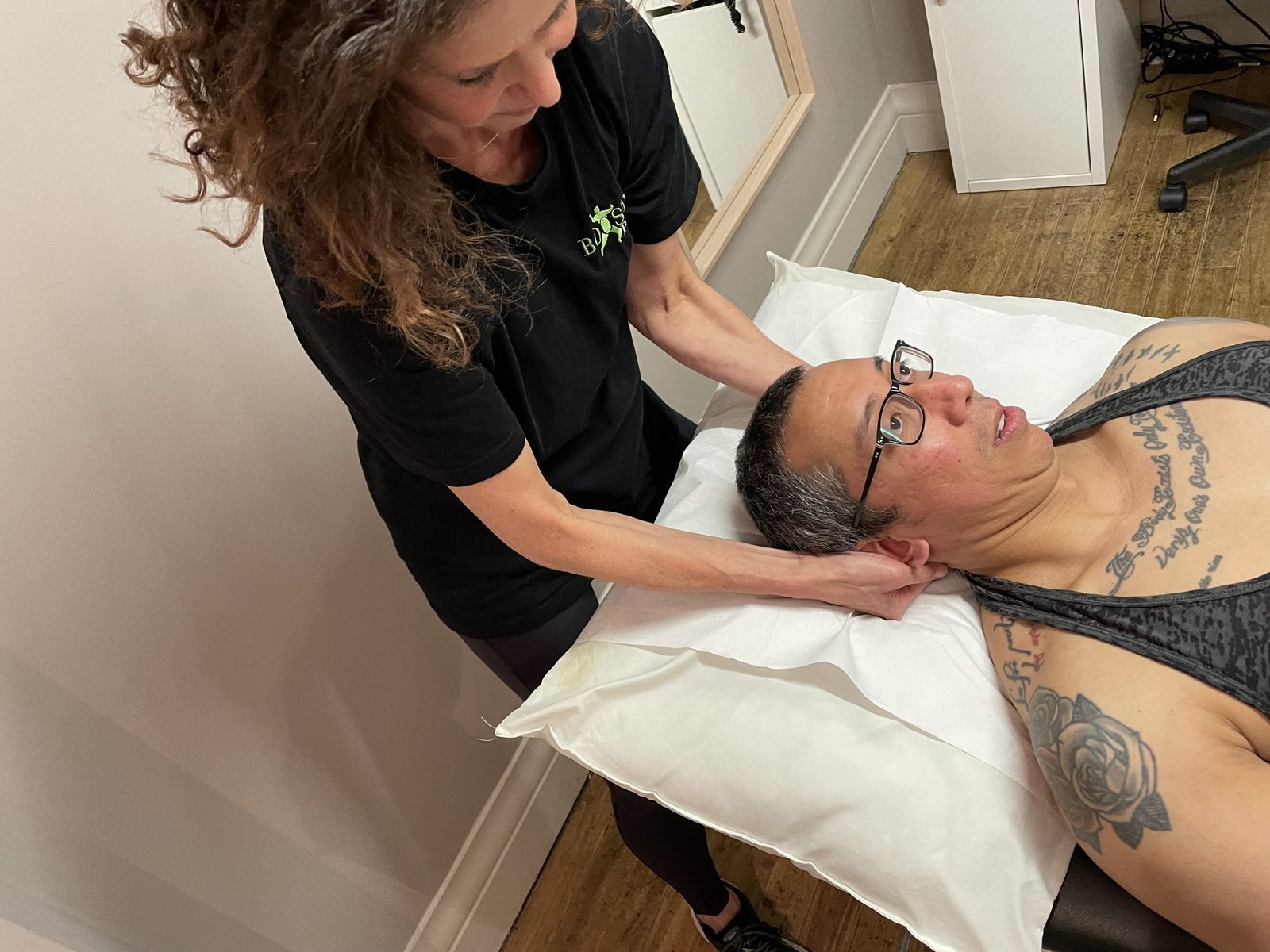
Your physiotherapist will begin with a thorough assessment, taking a detailed history of your symptoms and how they are triggered. They will then perform specific positional tests, the most important of which is the Dix-Hallpike test. This involves lying back on the treatment bed with the head turned to one side. If BPPV is present, this position will typically reproduce the vertigo and a characteristic rapid eye movement known as nystagmus. This test helps confirm both the diagnosis and identifies which ear and which canal is affected - which is important, as it determines the exact treatment approach.
The Dix-Hallpike test can momentarily bring on your symptoms, which can feel uncomfortable, but it is safe, brief and essential for accurate diagnosis and effective treatment.
Step 2 - The Epley Manoeuvre
Once the affected canal has been identified, your physiotherapist will perform a canalith repositioning manoeuvre. For the most common form of BPPV - affecting the posterior semicircular canal - this is known as the Epley Manoeuvre, named after the American physician Dr John Epley who developed it in the 1980s.
The Epley Manoeuvre involves guiding the head through a specific sequence of positions whilst the patient lies on the treatment bed. Each position is held for approximately 30 seconds. The aim is to use gravity to guide the displaced crystals back out of the semicircular canal and into a part of the inner ear where they can be safely reabsorbed without causing symptoms.
The manoeuvre is gentle, non-invasive and highly effective. Research consistently shows success rates of over 80% following one or two treatments. For many patients, the relief is immediate and dramatic - the spinning simply stops.
Other repositioning manoeuvres may be used depending on which canal is affected. Your physiotherapist will select the most appropriate technique for your presentation.
Step 3 - Vestibular rehabilitation and home exercises
For some patients, particularly where BPPV has been present for some time, the brain may have adapted to the abnormal signals in ways that cause ongoing imbalance or unsteadiness even after the crystals have been repositioned. In these cases, your physiotherapist may prescribe a programme of vestibular rehabilitation exercises.
These exercises are designed to retrain the balance system, improve gaze stability, reduce dizziness with movement and restore confidence. They are typically straightforward and can be performed at home. Your physiotherapist will guide you through them and adjust the programme as you progress.
You will also receive clear advice on what to do and what to avoid in the days following treatment, and how to recognise whether BPPV has recurred.
What If My Dizziness Is Not BPPV?
Dizziness and vertigo have several possible causes, and not all of them are BPPV. Other vestibular conditions our physiotherapists are experienced in assessing and managing include:
- Cervicogenic dizziness - dizziness originating from tightness or dysfunction in the joints and muscles of the neck
- Vestibular neuritis - inflammation of the vestibular nerve, usually following a viral illness, causing prolonged unsteadiness
- Labyrinthitis - inner ear inflammation affecting both hearing and balance
- Vestibular migraine - episodes of vertigo or dizziness associated with migraine, sometimes occurring without headache
- Persistent Postural-Perceptual Dizziness (PPPD) - a chronic functional dizziness often triggered by an initial vestibular event, characterised by persistent swaying, unsteadiness or motion sensitivity
A careful assessment will help identify which type of dizziness you are experiencing and determine the most appropriate treatment approach. If your symptoms suggest a cause outside the scope of physiotherapy, your physiotherapist will advise you accordingly and suggest the right onward referral.
What Our Patients Say
"I went in barely able to walk without holding onto something, dizzy from BPPV. Within one session, using the Epley Manoeuvre, my physio had me sorted. I walked out feeling completely normal. I was absolutely amazed. Cannot recommend BOOST PHYSIO highly enough."
★★★★★ Five-star Google review – Read the full review
Meet Our BPPV and Vestibular Specialists
The following BOOST PHYSIO clinicians have experience assessing and treating BPPV, dizziness and vestibular conditions, including the Epley Manoeuvre:
- Michael English – Specialist Physiotherapist, Hendon NW4 & Hampstead Garden Suburb NW11
- Dan Burgin – Sports Rehabilitation Therapist, East Finchley N2 & Elstree WD6
- Sarah Shamia – Chartered Physiotherapist, Hendon NW4
- Aaran Purwaha-Sidhu – Senior Physiotherapist, Hendon NW4
- Alice Matravers – Senior Physiotherapist, Hampstead NW3 & Swiss Cottage NW3
- Travis Egerton – Chartered Physiotherapist, Hampstead NW3 & Swiss Cottage NW3
- Madeleine Paterson – Senior Physiotherapist, Hampstead NW3 & Kensington W8
- Tosin Eyitayo – Specialist Physiotherapist, East Finchley N2
If you are unsure which clinician to book with, simply call your nearest clinic and our team will match you with the right person for your needs.
Why Choose BOOST PHYSIO for Vertigo Treatment?
- Over 1,000 five-star Google reviews - our patients trust us to get them better, faster
- Same-day appointments available across all our clinics - no long waits when you are suffering
- Expert hands-on treatment - we are manual therapy specialists; we do not just advise, we treat
- Average of four treatments to resolve a problem - and for straightforward BPPV, often fewer
- No GP referral required - book directly at a time that suits you
- 10+ clinics across North London and Hertfordshire - we are conveniently close to you
- Recognised by major insurers - BUPA, AXA Health, Vitality and WPA
Frequently Asked Questions
Ready to stop the spinning?
Do not struggle on with BPPV when effective, fast treatment is available. Book today - no GP referral needed, same-day appointments frequently available.
Book Online Now 020 8201 7788